
Behind the Music: Villains
There is a reason the Book of Mormon remembers its villains.
It would have been possible to tell the story primarily through prophets, missionaries, warriors, kings, and people who chose faith. Instead, the record preserves the stories of people who rejected God, manipulated others, pursued power, distorted truth, and helped lead individuals and societies toward destruction.
Book of Mormon Songimonies — Villains was created to explore those stories.
Not to glorify them.
Not to make light of what they did.
And not to make evil entertaining for its own sake.
The purpose is to understand how deception works.
Each villain represents more than an individual antagonist in an ancient story. Their lives reveal different forms of temptation: pride, intellectual arrogance, flattery, ambition, greed, resentment, the hunger for influence, rejection of accountability, and the gradual normalization of things that once would have seemed unthinkable.
The album asks the listener to look beyond the villain and recognize the pattern.
The People Behind the Songs
The album focuses on the Book of Mormon figures whose stories provide particularly distinct warnings about how people can be persuaded away from truth and covenant living.
Sherem represents the challenge of persuasive unbelief. His story isn’t simply about someone who didn’t believe. It is about someone who actively attempted to persuade another person to abandon faith. His encounter with Jacob becomes a study in confidence, contention, and the difference between intellectual argument and spiritual knowledge.
Nehor represents the corruption that can occur when attractive ideas are combined with personal influence and self-interest. His teachings appealed to people while rejecting important principles of the gospel, and his actions introduced the Book of Mormon’s explicit discussion of priestcraft. His story demonstrates how easily something can appear appealing while quietly removing accountability.
Amlici represents the pursuit of political power and the consequences of allowing personal ambition to become more important than the agency of others. His story demonstrates how a desire for authority can transform disagreement into division and ultimately violence.
Korihor represents another kind of deception: the insistence that only what can be demonstrated according to one’s own chosen standards can be true. His arguments against God, prophecy, sin, and Christ are among the Book of Mormon’s clearest encounters with intellectual skepticism. Yet his story ultimately reveals something deeper than an argument about evidence. It becomes a story about deception itself.
Amalickiah represents calculated ambition. His story moves beyond disagreement or unbelief into manipulation, betrayal, political maneuvering, murder, and warfare. He is particularly important to the album because his actions demonstrate what can happen when obtaining power becomes more important than the people being used to obtain it.
These aren’t simply stories about “bad people.”
They are stories about choices.
And that distinction is important.
The Villains Are Ancient. The Temptations Aren’t.
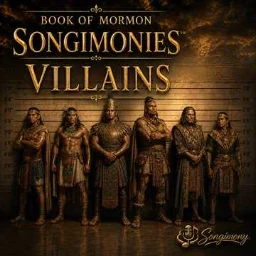
One of the most intentional visual ideas behind the album is its artwork.
The album cover presents a modern lineup of the ancient villains.
They are presented almost as though these figures have been assembled for a contemporary portrait—recognizable faces from a world thousands of years removed from our own, placed together as though they could walk into the present day.
That creative decision is more than an aesthetic choice.
It asks a question:
What if these weren’t merely characters from an ancient record?
What if the same temptations existed today?
The people themselves are ancient.
The methods are not.
Pride doesn’t require an ancient civilization.
Flattery doesn’t belong to one historical period.
Ambition doesn’t disappear with the rise and fall of kingdoms.
People can still be persuaded by arguments that tell them exactly what they want to hear. They can still trade principles for influence. They can still convince themselves that their desires justify their actions.
The modern presentation of these ancient figures therefore creates an intentional tension: they look like people who could belong to our world because the human weaknesses exposed in their stories still belong to ours.
The album artwork becomes a visual extension of the central message.
These aren’t museum pieces.
They are warnings.
What Did They Believe?
One of the most important decisions in creating the album was not to portray these figures simply as monsters.
Doing that would actually make the stories less useful.
If the villains were completely alien to ordinary human experience, the natural response would be, “I would never become someone like that.”
The Book of Mormon invites a much more uncomfortable response:
Where does the path begin?
Nehor didn’t begin with the destruction of a civilization.
Korihor didn’t begin with the complete rejection of everything sacred.
Amalickiah didn’t begin with an army behind him.
The destructive outcomes came after choices, and those choices developed through beliefs, desires, and actions.
That is what makes these stories valuable.
The Deceptions Behind the Destruction
Across the album, several patterns emerge.
Truth can be replaced by what is appealing.
An idea can become attractive because it removes something difficult—accountability, repentance, sacrifice, humility, or obedience.
Confidence can become pride.
There is a difference between honestly searching for truth and becoming so convinced of one’s own understanding that correction itself becomes unacceptable.
Flattery can disguise manipulation.
People are often vulnerable when someone tells them what they want to hear about themselves.
Freedom can be confused with freedom from consequences.
The Book of Mormon repeatedly challenges the idea that agency means there is no moral reality attached to our choices.
Ambition can slowly become domination.
The desire to accomplish something can become dangerous when people become tools rather than individuals with agency and worth.
Contention can become identity.
Once disagreement becomes more important than truth or relationships, conflict can become self-sustaining.
And perhaps most importantly:
Deception rarely introduces itself as deception.
That may be the most important lesson of the entire album.
The Songs as Warnings
The Songimony approach allows each story to become more than a retelling.
The goal isn’t simply to summarize what happened in the scriptures.
Each song seeks to place the listener inside the emotional and spiritual tension of the story.
What would it have felt like to believe the argument?
What desire was being appealed to?
What did the person think he was gaining?
What did he fail to see?
And what did his choices ultimately cost?
That perspective makes the songs less like historical character studies and more like cautionary mirrors.
The listener isn’t being asked to admire the villain.
The listener is being asked to recognize the temptation.
Why Make an Album About Villains?
Because warnings are part of scripture.
The Book of Mormon doesn’t only record people who succeeded.
It records people who failed.
It records arguments that persuaded people.
It records societies that became vulnerable to corruption.
It records people who had opportunities to turn back and people who continued down destructive paths.
Those stories were preserved for a reason.
They give us the opportunity to see consequences without having to experience every consequence ourselves.
That is the purpose of Book of Mormon Songimonies — Villains.
The album takes figures from an ancient record and asks modern questions.
How easily can pride disguise itself as confidence?
How can flattery influence our decisions?
When does ambition stop being achievement and become the desire to control?
Are we willing to change our beliefs when truth challenges us?
Do we recognize when an appealing message is quietly removing accountability?
Can we recognize deception before it becomes destruction?
The Villains Are Not the Message
Ultimately, this album isn’t about giving the villains the final word.
They don’t get it.
The Book of Mormon gives them a voice so that we can understand what they said—but it also preserves the consequences of believing them.
The larger message is found in the contrast.
Where pride leads one person toward self-exaltation, humility leads another toward God.
Where deception seeks control, truth invites agency.
Where ambition uses people, Christ serves people.
Where flattery inflates the individual, the gospel calls the individual to repentance and transformation.
And where these stories show the consequences of turning away from God, the broader Book of Mormon continually points back toward Jesus Christ as the source of repentance, redemption, covenant, and hope.
That is why the villains deserve to be remembered.
Not because their deeds deserve celebration.
But because their mistakes can become our warnings.
The modern faces on the album cover are ancient faces.
The battles they fought are ancient battles.
The kingdoms they influenced are gone.
But the temptations are still recognizable.
And perhaps that is the most unsettling—and ultimately most useful—thing about Book of Mormon Songimonies — Villains:
The villains lived thousands of years ago. The choices they faced did not.