
Discovering the Story, Symbolism, and Meaning Behind the Sword of Laban
There are objects in scripture that we encounter so often that we can stop seeing them.
The Sword of Laban can be one of those objects.
We meet it in one of the most difficult and dramatic episodes in the Book of Mormon. Nephi enters Jerusalem. He finds Laban. He sees the sword. He is commanded by the Spirit to take Laban’s life. He takes the sword, puts on Laban’s armor, obtains the brass plates, and escapes the city.
Then the story moves on.
But what happens if we don’t move on?
What happens if we stop and ask:
Why this sword?
Why does Nephi describe its workmanship?
Why does the Book of Mormon continue mentioning it?
Why does it remain with the Nephite kings?
Why is it included with the sacred records and the Liahona?
Why does King Benjamin possess it?
Why is it passed from one generation to another?
Why does it matter enough that the sword becomes part of the story of the Restoration?
And perhaps the most important question:
Was the Sword of Laban simply a weapon—or was it something much more?
Those questions became the beginning of The Sword.
Beginning With the Story
The first discovery was that the sword’s story begins in a moment of profound tension.
Nephi does not approach Laban wanting to kill him.
He explicitly says that he had never shed the blood of a man and that he “shrunk” from doing it.
He had already attempted to obtain the plates through other means.
Only after those attempts failed did Nephi receive the command that would change the course of his family’s history.
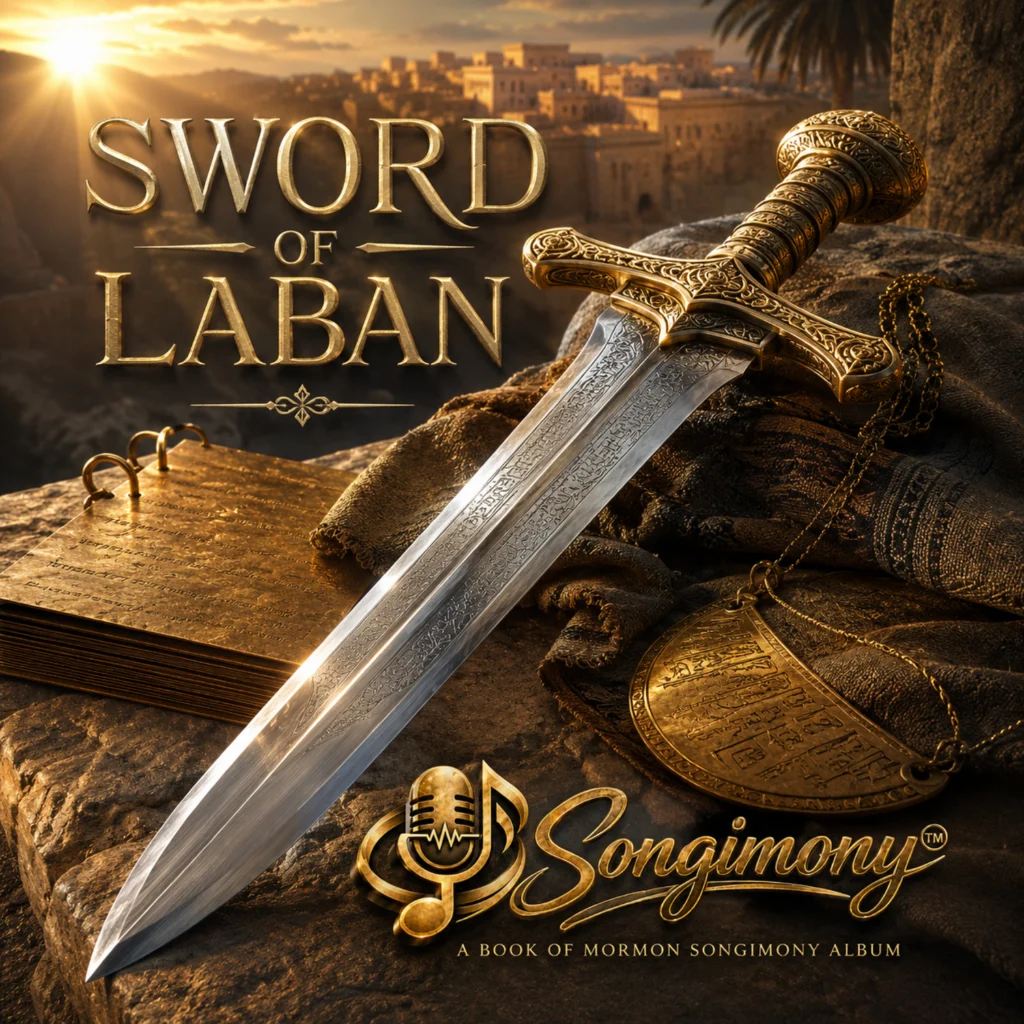
The Book of Mormon says Nephi was led by the Spirit, “not knowing beforehand” what he would do. When he encountered Laban, he noticed the sword first: a weapon with a gold hilt, fine workmanship, and a blade of precious steel. (The Church of Jesus Christ)
Then came the command.
Nephi used Laban’s own sword to obtain the plates.
That detail is easy to overlook.
The instrument belonging to Laban becomes the instrument through which the Lord preserves the records.
The weapon of one man becomes part of the preservation of an entire covenant people.
That was our first major shift in perspective.
The story wasn’t really about a sword.
It was about what the sword would come to represent.
The Sword and the Plates
The reason Nephi ultimately gives for obeying the command is especially important.
The brass plates contained the law.
Without them, Nephi’s descendants would not have had the scriptural record necessary to preserve their language, traditions, prophecies and knowledge of God.
Nephi understood that the Lord had delivered Laban into his hands so that he could obtain the records according to the commandment. (The Church of Jesus Christ)
This creates a remarkable relationship between the two objects.
The sword represents preservation of the people.
The plates represent preservation of the word.
One protects the people physically.
The other preserves them spiritually and culturally.
And both become part of the sacred inheritance passed from generation to generation.
The Sword Was Not Just a Weapon
As the research continued, one of the most significant discoveries came from examining what happened to the sword after Nephi.
The story doesn’t end in Jerusalem.
Nephi takes the sword with him.
Later, he makes swords “after the manner” of the Sword of Laban so that his people can defend themselves. The sword therefore becomes a model—not simply an artifact. The original becomes the pattern from which other instruments of defense are made.
The Church’s scripture index traces the Sword of Laban through Nephi’s descendants and specifically identifies its continuing presence among the Nephites. (The Church of Jesus Christ)
Then something even more interesting happens.
The sword becomes part of the sacred objects associated with Nephite leadership.
From Nephi to Kings
King Benjamin is one of the most important figures in understanding the sword.
The Words of Mormon tells us that Benjamin fought to defend his people with the Sword of Laban, and that he did so “in the strength of the Lord.” (The Church of Jesus Christ)
That combination is important.
Benjamin wasn’t simply a warrior.
He was remembered as a righteous king, teacher, record keeper and servant of his people. Church materials emphasize that his significance wasn’t merely his military strength but his righteousness, humility and service. (The Church of Jesus Christ)
The sword therefore becomes associated with a very different kind of power.
It is not simply:
power over people.
It becomes:
power exercised in defense of people.
That distinction became one of the central themes of the album.
The Sword as a Symbol of Authority
The deeper research eventually led to a significant academic treatment of the subject.
Brett L. Holbrook’s study, The Sword of Laban as a Symbol of Divine Authority and Kingship, examines the sword within the broader ancient pattern in which swords could function as symbols of divine authority, kingship and legitimate rule.
Holbrook argues that the Sword of Laban fits this pattern and traces it as part of the royal regalia associated with Nephite leadership. (BYU ScholarsArchive)
This gave us an entirely different way to hear the story.
The sword isn’t merely something Nephi happened to acquire.
It becomes a symbol of legitimate authority.
And that changes the meaning of almost everything that follows.
Why Was It Passed Down?
One of the most striking passages appears in Mosiah 1.
King Benjamin prepares to transfer responsibility for the kingdom to his son Mosiah.
And among the things Benjamin gives Mosiah are:
- the sacred records
- the plates
- the Sword of Laban
- the Liahona
The text calls this a “charge” concerning the affairs of the kingdom. (The Church of Jesus Christ)
That word—charge—became important.
Benjamin isn’t simply handing his son some old possessions.
He is transferring a responsibility.
The objects represent things that must be protected, preserved and faithfully transmitted.
The records preserve truth.
The Liahona represents divine direction.
The sword represents authority and defense.
Together, they form a remarkable picture of leadership.
Know the truth.
Follow divine direction.
Protect what has been entrusted to you.
The Sword and the Liahona
This was another important discovery.
The Sword of Laban and the Liahona appear together in Mosiah 1.
That pairing is fascinating.
One points.
One protects.
One provides direction.
One represents defense.
One speaks to where to go.
The other speaks to what must be protected along the way.
The Book of Mormon itself makes a connection between faithfulness and progress: when Lehi’s family gave heed and diligence to the director, they progressed; when they were unfaithful, they did not. (The Church of Jesus Christ)
That created one of the album’s conceptual questions:
What happens when a person has direction but no courage to act?
And the opposite:
What happens when someone has power but no direction?
The two objects together suggest something profound.
Power needs direction.
Direction requires faithfulness.
And leadership requires both.
The Sword and Kingship
The research also revealed that the sword’s significance becomes particularly interesting when we look at the transition of Nephite government.
The Sword of Laban is associated with kingship, but kingship eventually ends.
Mosiah establishes a system of judges.
Yet the sacred objects associated with authority continue to matter.
Scholars have argued that the sword remained part of the sacred implements associated with legitimate authority even as the political structure changed. (Scripture Central)
That suggests something larger than monarchy.
The sword isn’t ultimately about having a crown.
It’s about stewardship.
Authority isn’t primarily about privilege.
It is about responsibility.
The person holding the sword isn’t being told:
“You are more important than everyone else.”
He is being told:
“You have been entrusted with something that must be protected.”
That distinction became central to the album’s interpretation of power.
The Sword of a Servant King
That is why King Benjamin became such an important part of the story.
Benjamin possessed the weapon of a warrior.
But his greatest legacy wasn’t violence.
It was service.
He taught his people that when they were in the service of their fellow beings, they were in the service of God.
He taught them about humility.
He taught them repentance.
He taught them the Atonement of Jesus Christ.
He taught them to become spiritually changed.
And the man who had literally carried the Sword of Laban ultimately used his influence to teach his people how to become a covenant people.
That created an extraordinary contrast.
The sword represents strength.
Benjamin teaches that strength must be governed by righteousness.
The strongest leader isn’t necessarily the person who can defeat everyone else.
It may be the person who has the power to destroy but chooses instead to serve.
Why the Sword Is Described as Beautiful
Another question that emerged from the research was the description of the sword itself.
Nephi didn’t simply say:
“I saw Laban’s weapon.”
He describes the hilt as pure gold.
He describes its workmanship as exceedingly fine.
He describes the blade as precious steel. (The Church of Jesus Christ)
Why include that detail?
One possibility is simply that Nephi was documenting an important artifact.
But symbolically, the description contributes something else.
The sword is beautiful and dangerous at the same time.
It possesses craftsmanship and destructive power.
That duality became important to the music.
Strength itself is morally neutral.
Power can protect.
Power can destroy.
Authority can serve.
Authority can oppress.
Courage can defend truth.
Courage can also become recklessness.
The question isn’t whether we possess strength.
The question is what governs it.
The Sword of Laban and the Sword of Goliath
The research eventually led us to another fascinating comparison.
The Sword of Laban has notable parallels with the sword of Goliath.
Both are associated with a powerful enemy.
Both are taken by a younger faithful warrior after the enemy is defeated.
Both become revered objects.
Both become associated with national leadership.
And both become symbols of legitimate authority. (Scripture Central)
The comparison opens another layer of the story.
David’s sword represents the defeat of Goliath.
Nephi’s sword represents the preservation of the covenant record.
In both cases, something that belonged to the enemy becomes part of the future of God’s people.
The symbolism is powerful:
What was intended for destruction can become part of deliverance.
The Sword Becomes an Heirloom
The Sword of Laban survives.
It is handed down.
It remains connected to the leaders of the Nephite people.
It becomes part of their collective memory.
It represents something that happened in the past—but continues to shape the future.
This was one of the discoveries that transformed the album concept.
The sword is an heirloom of faith.
It is a physical reminder that someone before you made a difficult choice.
Someone before you obeyed.
Someone before you defended something sacred.
Someone before you carried the responsibility.
And now it is your turn.
A Sword Can Be Inherited—but Responsibility Cannot Be Automated
This became another major theme.
Mosiah inherits the sword.
But he cannot simply inherit Benjamin’s righteousness.
The object can be passed from father to son.
The responsibility must be accepted anew.
Faith cannot simply be inherited.
Covenants cannot simply be inherited.
Testimony cannot simply be inherited.
Leadership cannot simply be inherited.
The sword can be placed in your hand.
What you do with it is still your choice.
That became one of the album’s most important questions.
The Sword in the Restoration
The story doesn’t end with the Nephites.
According to the Church History Library, Joseph Smith did not receive permanent possession of the Sword of Laban. The Church does not have the sword today. However, the historical record indicates that Moroni showed the sword, along with other sacred items, to Joseph Smith and the Three Witnesses. Moroni then took it with him. (Church History Library)
That detail matters because it prevents us from turning speculation into doctrine.
There have been later stories about the sword and a possible cave at Cumorah, but the Church History Library distinguishes those later accounts from what can actually be established historically. (Church History Library)
The more important point is simpler:
The sword appears again in the Restoration story.
And that creates an extraordinary arc.
Nephi receives it.
The Nephite kings preserve it.
It survives through generations.
Moroni possesses it.
Joseph Smith and the Three Witnesses see it.
Then Moroni takes it away.
The physical object becomes another thread connecting the beginning of the Book of Mormon narrative to its Restoration.
From Weapon to Witness
That may be the most remarkable transformation of all.
At the beginning of the story, the sword is a weapon.
By the end, it has become a witness.
It witnesses to Nephi.
It witnesses to the Nephite kings.
It witnesses to the preservation of the records.
It witnesses to the continuation of divine authority.
And in the Restoration narrative, its appearance becomes part of the broader testimony surrounding the Book of Mormon and Joseph Smith’s prophetic calling. Holbrook’s research specifically argues that the sword’s association with Joseph Smith functioned as an additional witness of divine sanction. (BYU ScholarsArchive)
The sword therefore moves through several identities:
weapon → instrument → heirloom → symbol → witness.
That progression became the conceptual backbone of The Sword.
What We Learned About Strength
The deeper we went into the story, the less the album became about warfare.
It became about strength under covenant.
Real strength isn’t simply the ability to fight.
It is the ability to stand.
To protect.
To endure.
To obey.
To sacrifice.
To lead.
To serve.
To defend what matters.
And sometimes, perhaps most importantly, to know when the sword should remain sheathed.
The Sword of Laban is a weapon.
But the people who carried it were ultimately judged by something greater than their ability to wield it.
They were judged by what they did with the responsibility they had been given.
What We Learned About Leadership
The sword also changed the way we thought about leadership.
Leadership isn’t ownership.
It is stewardship.
Benjamin didn’t truly own the kingdom.
He had a responsibility to God and to his people.
He didn’t simply give Mosiah a collection of artifacts.
He transferred a charge.
That idea reaches far beyond ancient kings.
Parents receive a charge.
Church leaders receive a charge.
Teachers receive a charge.
Communities receive a charge.
Each generation receives things from the generation before it.
Truth.
Faith.
Stories.
Covenants.
Scripture.
Traditions.
Responsibilities.
And then comes the question:
Will we preserve them?
What We Learned About Inheritance
Perhaps the most personal lesson of the sword is that every generation eventually receives something it didn’t create.
We inherit things.
We inherit the faith of parents and grandparents.
We inherit scripture.
We inherit testimony.
We inherit stories.
We inherit institutions.
We inherit responsibilities.
But inheritance creates a choice.
We can preserve it.
We can strengthen it.
We can misuse it.
Or we can lose it.
The Sword of Laban becomes a powerful metaphor for that responsibility.
Someone carried it before us.
Someone trusted that it mattered.
Someone protected it.
Someone passed it forward.
And eventually it arrives in our hands.
Why We Made an Album About It
At some point, the project stopped being an attempt to tell the story of a sword.
It became an attempt to explore everything the sword had come to represent.
Courage.
Authority.
Faith.
Obedience.
Leadership.
Stewardship.
Inheritance.
Protection.
Sacrifice.
Righteous power.
The preservation of truth.
The responsibility of one generation to another.
And ultimately:
the question of what we will do with what God has placed in our hands.
That is what the songs are designed to explore.
The Music Had to Sound Like a Sword
Once the meaning became clearer, the musical direction changed.
The music could not simply be gentle scripture music.
The subject demanded weight.
Steel.
Movement.
Danger.
Authority.
But it also needed reverence.
The sound needed to contain both sides of the sword:
beauty and power.
strength and restraint.
battle and peace.
earthly conflict and spiritual purpose.
The arrangements therefore became part of the storytelling.
Percussion could suggest movement toward battle.
Low instrumentation could create weight.
Riffs could function almost like the repeated image of a blade.
Orchestral elements could expand the story beyond one man into generations.
And when the music rises, it isn’t simply becoming louder.
The meaning is becoming larger.
The Sword Is Ultimately About the Person Holding It
Perhaps the deepest discovery was this:
The power of the sword isn’t ultimately in the steel.
It is in the person holding it.
And even that isn’t enough.
The person holding it needs direction.
Nephi was not simply brave.
He was led.
Benjamin was not simply powerful.
He was righteous.
Mosiah did not simply inherit authority.
He inherited responsibility.
That brings us back to the relationship between the Sword and the Liahona.
Strength without direction is dangerous.
Direction without courage may accomplish nothing.
But when strength is governed by divine direction and used in service of others, it becomes something different.
It becomes stewardship.
The Question the Album Leaves With Us
The Sword of Laban is an ancient object.
But the question it raises is remarkably modern.
What has been placed in your hands?
What truth have you inherited?
What responsibility have you been given?
Who depends upon your courage?
What are you willing to defend?
What are you willing to sacrifice?
What will you pass to the generation that comes after you?
And perhaps the most important question:
When your time is over, will what was entrusted to you be stronger because you carried it?
The Sword
The album began with a weapon.
It became a study of leadership.
It became a study of authority.
It became a study of inheritance.
It became a study of faith.
It became a study of covenant responsibility.
And eventually it became a meditation on something much larger:
what it means to be entrusted with something sacred.
The Sword of Laban began in the hand of Laban.
It passed into the hands of Nephi.
It became an instrument of preservation.
It became an emblem of Nephite leadership.
It was carried by King Benjamin.
It was passed from generation to generation.
It became part of the sacred inheritance of the Nephite civilization.
And in the Restoration narrative, it appeared again as one of the sacred objects associated with the coming forth of the Book of Mormon. (The Church of Jesus Christ)
Its physical story is extraordinary.
But its symbolic story may be even more important.
Because eventually every generation receives its own version of the sword.
Not necessarily a weapon.
But something entrusted to it.
A testimony.
A family.
A covenant.
A responsibility.
A truth.
A calling.
A people to protect.
A future to preserve.
And when that moment comes, the question is no longer:
“What did the people before me do with the sword?”
The question becomes:
“What will I do with what has been placed in my hands?”
That is the question at the heart of The Sword.
And that is why the story of a sword that began more than two thousand years ago can still speak to us today.