
Behind the Music: The Periodic Table of Elements
From the Songimony Learning Collection
There are some things students are asked to remember that seem almost designed to resist memory.
A list of names. A sequence of terms. A chart filled with unfamiliar symbols. Definitions that can feel disconnected from anything happening in everyday life.
The periodic table can be one of those things.
The challenge isn’t necessarily that chemistry is uninteresting. It is that the periodic table contains an enormous amount of information. Asked to memorize 118 elements individually, a student can quickly encounter a wall of disconnected facts.
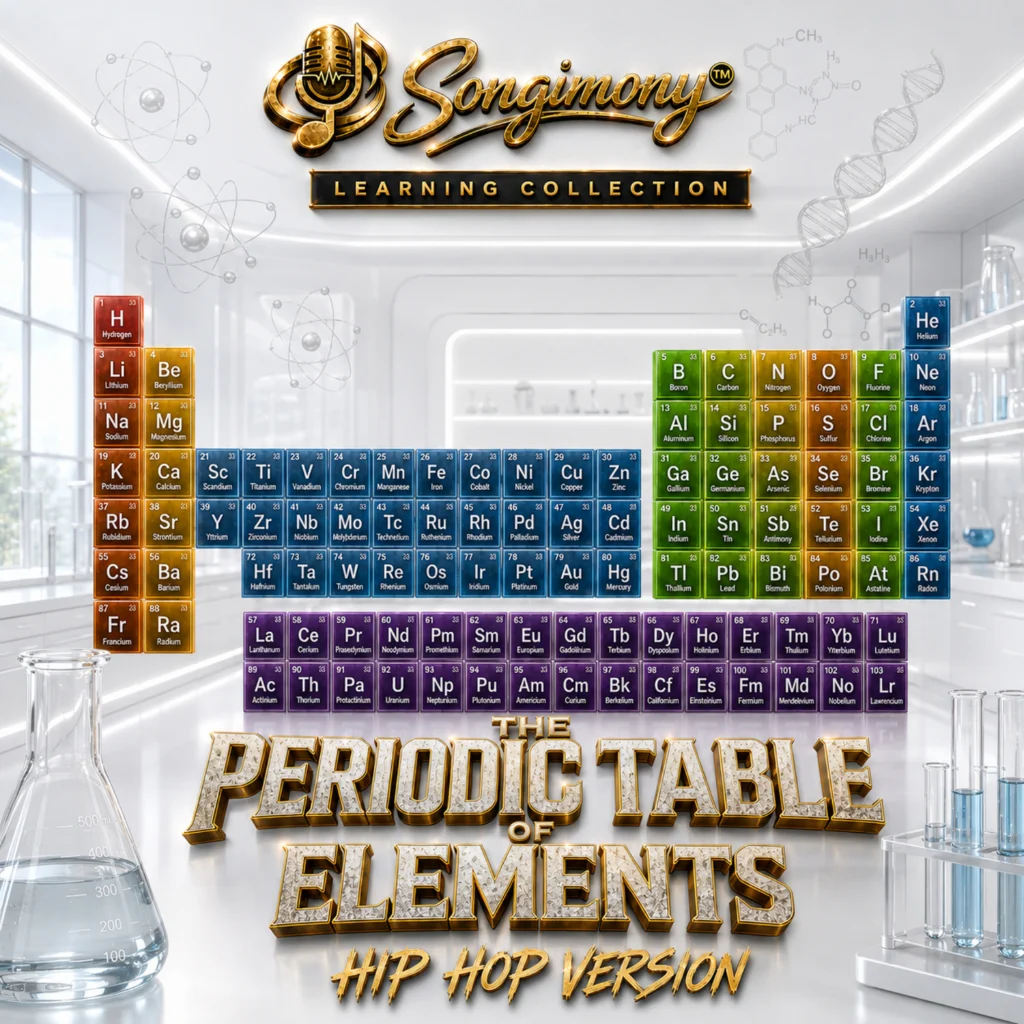
That was the starting point for The Periodic Table of Elements, part of the Songimony Learning Collection.
The goal was not to turn all 118 elements into a hundred-plus songs.
The goal was to help students understand the story behind the table.
Why This Album Exists
The periodic table is not simply a list of elements arranged in boxes. Its organization reveals relationships. Elements belong to families. Those families share characteristics, patterns, behaviors, and tendencies.
That observation shaped the entire project.
Instead of creating one song for every element, the album approaches chemistry through the major elemental families. Each song introduces a group as a kind of character in the larger story of matter.
Hydrogen becomes the beginning.
The alkali metals become the family that is always ready to react.
The alkaline earth metals bring greater stability and strength.
The transition metals become the builders and workhorses.
The carbon family demonstrates extraordinary variety.
The nitrogen and oxygen families reveal how seemingly ordinary elements are essential to life.
The halogens become the connection seekers.
The noble gases are perfectly content not to react.
The lanthanides quietly help make modern technology possible.
The actinides introduce the extraordinary energy contained within atoms—and the responsibility that comes with understanding and using that energy.
By giving each family a recognizable identity, the album attempts to turn an abstract chart into something students can mentally organize.
Why Not Make 118 Songs?
Because more information isn’t necessarily better learning.
One song for every element could certainly contain more facts, but it could also create a much larger memorization problem. Students might remember individual songs without understanding how the elements relate to one another.
The family approach creates a framework.
Instead of asking a student to remember 118 isolated pieces of information, the album gives them a set of categories they can use to organize what they learn.
It is the difference between memorizing a pile of puzzle pieces and first seeing the picture on the box.
Once students understand the families, individual elements have somewhere to belong.
That makes it possible to return to the periodic table later and say, “I remember this family. I remember what makes them different. Now I can place this element within that story.”
The music becomes an introduction to the architecture of the table rather than a replacement for studying it.
Giving Chemistry a Personality
One of the creative decisions behind the album was to give each family a recognizable personality without sacrificing scientific accuracy.
This is where humor became particularly useful.
The humor isn’t intended to ridicule science or turn chemistry into a cartoon. Instead, it comes from observing the real behavior of the elements and translating those characteristics into familiar human situations.
The noble gases don’t need to be mocked for being unreactive. They can simply be imagined as the people at the party who are perfectly comfortable standing by themselves.
The halogens are always looking for another electron.
The alkali metals are highly reactive and can be portrayed as the family that is perhaps a little too eager to make connections.
Carbon has an almost absurd résumé: life, diamonds, graphite, and countless compounds.
These observations create memorable associations while remaining rooted in actual chemistry.
A student may remember a scientific fact because the fact was attached to a personality.
That is one of the central ideas behind Songimony Learning: sometimes the path to remembering information is making the information meaningful first.
Why Hip-Hop?
The album deliberately opens the door to musical styles that feel appropriate for older students.
Educational music can sometimes sound like it was written specifically for young children. That becomes a problem as students get older. A middle-school or high-school student may still benefit enormously from repetition and musical memory, but they may be much less interested in listening to something that sounds like preschool music.
That is why hip-hop became an important part of the musical vocabulary surrounding this project.
Hip-hop naturally emphasizes rhythm, repetition, verbal patterns, rhyme, cadence, and recall. Those characteristics make it particularly well suited to information that has to be remembered.
A sequence of names can become a rhythmic pattern.
A scientific definition can become a lyrical hook.
A list of characteristics can become a verse.
And repetition can happen without feeling like repetition.
The intent isn’t to make chemistry “cool” by forcing it into a genre. The intent is to meet students in musical territory they already understand and use that musical structure as a vehicle for learning.
The album can also move beyond hip-hop. Pop, alternative, rock, electronic, funk, and cinematic sounds give different scientific families different musical identities.
That variety was intentional.
Chemistry is diverse. The music should be, too.
Music as a Memory Tool
The educational premise behind the project is straightforward: music can provide additional cues for recalling information.
When information is attached to rhythm, melody, repetition, rhyme, and emotional association, students have more than one pathway by which to retrieve it.
Think about how easily many people can remember song lyrics from decades ago while struggling to remember information they studied for an exam last month.
That doesn’t mean putting every textbook chapter to music will automatically make it memorable. Nor does it mean music replaces instruction, practice, reading, or understanding.
It means music can become another tool.
A melody can provide a sequence.
A rhythm can provide structure.
A chorus can reinforce the central concept.
A recurring phrase can become a retrieval cue.
And a distinctive musical style can help separate one concept from another.
The objective of Songimony Learning is to explore that potential responsibly: not replacing education with entertainment, but using entertainment to make educational information easier to engage with and remember.
Building From One Family to the Next
The sequencing of the album was also deliberate.
Hydrogen begins the journey with the simplest element and the first entry on the table.
The early metal families introduce reactivity, bonding, strength, and structure.
The transition metals expand the story into the materials and technologies surrounding us.
The carbon family provides a bridge into life and molecular diversity.
The nitrogen and oxygen families connect chemistry to the air we breathe and the biology of living systems.
The halogens and noble gases provide a memorable contrast between elements eager to react and elements known for their stability.
The lanthanides bring the periodic table into modern technology.
The actinides take the listener deeper into atomic energy, scientific discovery, and responsibility.
Finally, the album steps back and looks at the entire table.
Everything is connected.
That is the conceptual destination of the album.
Entertainment Is Part of the Strategy
The music was intentionally written to sound like music students might actually choose to hear.
That meant using modern production, mature vocals, memorable hooks, varied genres, layered harmonies, electronic textures, guitars, drums, orchestration, and cinematic elements.
It also meant allowing the songs to breathe.
The educational information doesn’t have to occupy every second.
There can be a groove.
There can be a musical hook.
There can be humor.
There can be a moment where the student simply enjoys the song.
That matters because the ideal outcome isn’t for a student to think, “I am listening to an educational song.”
The ideal outcome is:
“I like this song.”
And then, somewhere along the way:
“Wait—I remember that.”
A Door Into Something Bigger
The Periodic Table of Elements is also an experiment in what Songimony Learning could become for older students.
There are students who understand concepts but struggle to recall terminology.
There are students who can explain an idea but forget the sequence of information.
There are students who need repetition but become disengaged when repetition feels like studying.
There are students who learn through rhythm, sound, story, association, or patterns particularly well.
Educational music cannot solve every learning challenge, and it should never be presented as a substitute for teachers, textbooks, laboratories, practice, or individualized support.
But it can provide another doorway.
And that doorway doesn’t have to close when elementary school ends.
Songimony Learning can explore subjects appropriate for increasingly mature audiences—chemistry, physics, biology, astronomy, mathematics, anatomy, earth science, engineering, economics, history, language, and other subjects where understanding and recall matter.
The musical language can mature as the students do.
The humor can become more sophisticated.
The production can sound like contemporary music.
The lyrics can carry more complex ideas.
The goal remains the same: take something worth knowing and give it a form people want to remember.
The Bigger Idea
The periodic table represents something bigger than chemistry.
It demonstrates that complexity can emerge from relationships.
Individual elements have properties. Families reveal patterns. Those patterns create a framework. And that framework allows us to understand a world that initially seems impossibly complicated.
The album follows the same philosophy.
Don’t begin with 118 disconnected facts.
Begin with the structure.
Give the structure a story.
Give the story a rhythm.
Give the rhythm a melody.
And give students something they can return to.
The Periodic Table of Elements was created because learning doesn’t have to choose between being accurate and being entertaining.
Sometimes the best way to remember the building blocks of everything…
is to give them a song.