
The Vineyard: One Story, Many Languages
The story behind Songimony’s international Book of Mormon music project
There are songs that begin with a melody.
There are songs that begin with a personal experience.
And then there are songs that begin with scripture.
The Vineyard began with a question:
What would happen if the Book of Mormon itself became the source material for an international collection of songs—without translating one song into twenty-one languages, but instead allowing each language’s own Book of Mormon to give birth to its own song?
That question became the foundation for one of the most research-intensive projects in Songimony.
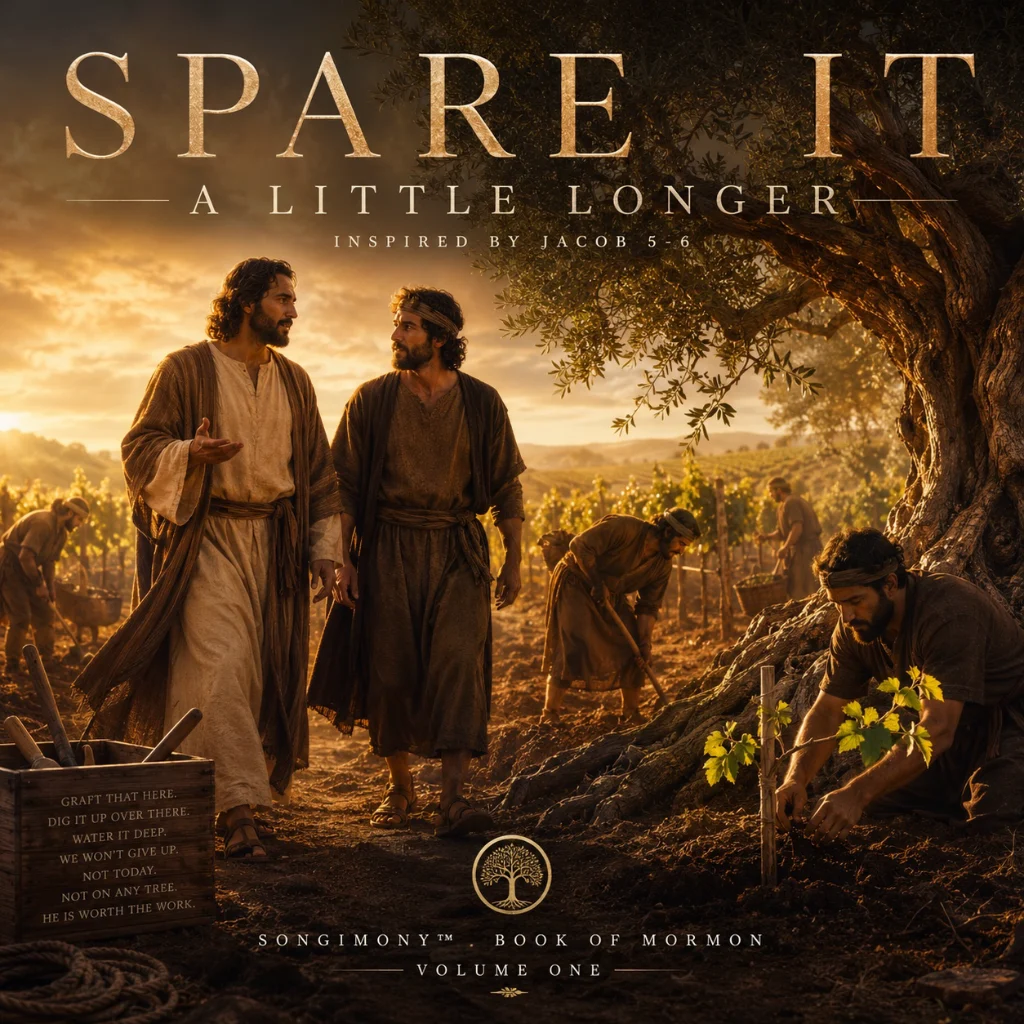
The result is an international album built around a single scriptural scene from Jacob 5: the master of the vineyard and his servant walking together among the olive trees, looking at what has grown, what has withered, what can still be saved, and what work remains.
It is a story about a vineyard.
But beneath the vineyard is something much larger.
It is a story about people.
About Israel.
About gathering.
About labor.
About patience.
About corruption and restoration.
And ultimately, about a Lord who is unwilling to give up on what He has planted.
Why Jacob 5?
Jacob 5 is one of the longest and most intricate chapters in the Book of Mormon. Jacob introduces the words of the prophet Zenos and presents an allegory of the tame and wild olive trees. The Lord of the vineyard repeatedly returns to the trees, examines their fruit, works the ground, prunes branches, grafts them, nourishes roots, and calls servants to labor with Him.
The Church’s own study material describes Jacob 5 as the allegory of the tame and wild olive trees, representing Israel and the Gentiles, with the scattering and gathering of Israel woven throughout the story. (Church of Jesus Christ)
But what made Jacob 5 especially compelling for music was not simply the allegory.
It was the conversation.
The chapter repeatedly places the Lord and His servant together in the vineyard.
They look.
They question.
They disagree.
They work.
The servant sees the deterioration.
The Lord sees what might still be preserved.
The servant asks what should be done.
The Lord answers.
And at the point where the vineyard seems to have reached its end, the servant says:
“Spare it a little longer.”
The Lord answers that He will.
The reason is extraordinarily personal: He grieves at the thought of losing the trees of His vineyard. (Church of Jesus Christ)
That exchange became the heartbeat of the album.
The line that became a song
Jacob 5:50–51 became the pivotal moment.
The servant asks that the tree be spared a little longer. The Lord agrees, and the work begins again—grafting, removing bitter branches, preserving roots, and laboring toward good fruit. (Church of Jesus Christ)
In the English song, the servant’s plea became:
“Spare it a little longer…”
That phrase is not merely a catchy chorus.
It is the scriptural hinge on which the entire song turns.
The verses imagine what it might sound like if the master and servant were actually walking through the vineyard together and discussing what they see.
The servant notices what is dying.
The Master remembers what can still live.
The servant sees failure.
The Master sees possibility.
The servant wonders whether the harvest is gone.
The Master keeps working.
And so the chorus becomes more than a refrain. It becomes the musical embodiment of Jacob 5’s central tension:
How long do we continue when the work appears to be failing?
Jacob 5 answers through action.
Continue.
Prune.
Dig.
Nourish.
Graft.
Labor.
Gather.
Try again.
But the project was never intended to translate that English song
This distinction became one of the most important principles of the entire project.
The international songs are not translations of the English song.
Instead, the English song serves as the storytelling model.
The English version was first studied to understand how the scripture had been transformed into a conversation:
- How does the Master speak?
- What does the servant notice?
- What questions naturally arise?
- How does the conversation extract the meaning of the chapter?
- Where does Jacob 5 become personal rather than allegorical?
- How does the servant’s plea become the chorus?
- How does the story build toward hope?
Once that structure was understood, the process was restarted independently for each language.
The source material became that language’s own published Book of Mormon.
The goal was simple:
How would the Master and servant naturally have this conversation if their words were being drawn from the Book of Mormon in this language?
That question changes everything.
A Hindi song should not sound like an English song translated into Hindi.
A Spanish song should not sound like an English song translated into Spanish.
An Arabic song should not sound like an English song translated into Arabic.
Each should sound as though the songwriter entered that language’s own Jacob 5, listened carefully to its vocabulary and expressions, understood the passage, and then wrote a song from inside that linguistic world.
Scripture became the linguistic source of truth
The research therefore went beyond finding equivalent words.
The Church provides Book of Mormon texts in a large number of languages, with its official translation resources documenting the languages, editions, publication histories, and revisions. (Church of Jesus Christ)
For this project, those published texts became the source of truth.
The songwriter studies the actual language used in Jacob 5.
Words for:
vineyard. master. servant. olive tree. branches. roots. fruit. pruning. digging. nourishing. grafting. gathering. labor. preserving.
But vocabulary alone isn’t enough.
The translated scripture also determines how these ideas are naturally expressed.
That means the resulting song can have a different sentence structure, different poetic movement, and different phrasing from the English song.
That is intentional.
The songs are meant to be siblings, not translations.
Why these 21 languages?
The international album currently includes:
English, Spanish, Mandarin Chinese, Portuguese, French, Russian, German, Japanese, Korean, Indonesian, Urdu, Swahili, Turkish, Italian, Vietnamese, Hindi, Persian, Arabic, Bangla (Bengali), Tamil, and Tagalog.
The list was built with two considerations in mind.
The first was human reach.
These languages represent enormous communities across Europe, Asia, Africa, the Middle East, and the Americas. Together they create a musical doorway into many of the world’s major language communities.
The second—and more important—was scriptural availability.
The project could not simply choose languages because they have large populations. The Book of Mormon itself needed to be available in the language through the Church’s published translation resources.
The Church’s translation record demonstrates the remarkable geographic and linguistic reach of the Book of Mormon. Spanish, for example, has a full translation dating to the nineteenth century; Chinese, Japanese, Korean, Indonesian, Hindi, Urdu, Arabic, Persian, Vietnamese, Tamil, Tagalog, Swahili, and many others have their own published translation histories. (Church of Jesus Christ)
The project therefore sits at the intersection of language, scripture, and global reach.
It is not an attempt to declare these languages more important than others.
It is a practical musical collection built from languages in which the Book of Mormon has been made available and that together provide a broad international footprint.
Why olive trees?
Jacob 5 does not use a generic garden as its central image.
It uses olive trees.
That matters.
The allegory’s agricultural language is unusually physical. The master does not simply watch the trees.
He works them.
He prunes.
He digs.
He nourishes.
He grafts.
He examines fruit.
He returns again and again.
The Church’s own materials describe the Lord and His servants laboring together in the vineyard, even after the roots have been overtaken and the fruit corrupted. (Church of Jesus Christ)
That physical labor became part of the musical language.
The song isn’t supposed to feel like a distant narration of scripture.
It is supposed to feel like two people walking through the vineyard.
The listener should almost be able to hear the footsteps.
See the branches.
Touch the soil.
Notice the damaged fruit.
And hear the conversation happening beside the trees.
Why the master and servant?
Because the relationship makes the allegory intimate.
If Jacob 5 were reduced to an explanation of Israel’s scattering and gathering, its emotional power could easily become abstract.
But the chapter gives us a relationship.
The Lord and the servant are together.
The servant asks questions.
The Lord answers.
They return to the vineyard repeatedly.
They work side by side.
That became the dramatic structure of the music.
The verses are conversational.
The pre-choruses reveal what is happening beneath the conversation.
The chorus becomes the collective voice of the laborers.
And the bridge asks the question that every person eventually asks when faced with the brokenness of the vineyard:
Will every tree receive Him?
The answer is not reduced to an easy promise.
Instead, the song returns to the central truth of the chapter:
The work continues.
Why one musical style across languages?
The album was deliberately designed so that the languages could change while the musical identity remained recognizable.
The foundational sound is dreamy, atmospheric alternative R&B with cinematic synth-pop textures:
warm analog synthesizers, electric piano, ambient electric guitar, rounded bass, restrained modern drums, subtle arpeggios, expansive reverbs, intimate male vocals, layered male harmonies, and a gradual cinematic lift.
That musical environment gives the languages room to breathe.
The prompt does not attempt to dictate every melodic note.
Instead, it tells the musical model to respect the natural phrasing, pronunciation, diction, stress, and melodic cadence of the target language.
This is important because languages do not all carry words rhythmically in the same way.
The music therefore remains related from song to song while allowing each language to shape its own vocal expression.
The Spanish version, for example, explicitly calls for natural Spanish phrasing and diction and instructs the music to use authentic Spanish Book of Mormon terminology rather than translated English sentence structure.
The same philosophy carries across the album.
The music is shared. The language is allowed to be itself.
The title is scripture
Another deliberate rule was established for every song:
Jacob 5:51 supplies the title and central chorus refrain in that language.
That means the title isn’t invented independently and then attached to Jacob 5.
The title comes from the scripture.
The English song uses:
Spare It a Little Longer
The Spanish song uses the corresponding scriptural refrain:
Déjala un poco más.
That wording appears directly in the official Spanish Jacob 5 text, where the servant says “Déjala un poco más” and the Lord answers, “Sí, la dejaré un poco más.” (Church of Jesus Christ)
This principle continues into every language.
The title becomes a kind of scriptural fingerprint for the song.
When the listener sees the title in Arabic, Hindi, Japanese, Korean, or another language, they are not seeing an English title translated into that language.
They are seeing the language’s own Jacob 5 speaking.
Why this particular passage for an international album?
Because Jacob 5 carries an unusually universal human question.
What do we do when something we care about is damaged?
Do we cut it down?
Do we walk away?
Or do we work a little longer?
The allegory is deeply specific to Israel and the prophetic record, but its emotional vocabulary reaches beyond geography.
It speaks about:
belonging. loss. restoration. patience. labor. hope. gathering. individual worth.
And it does so through a relationship that is remarkably easy to understand across cultures:
A master sees a vineyard.
A servant walks beside him.
Something is wrong.
They talk about it.
They work.
They return.
They refuse to give up.
That makes Jacob 5 uniquely suited to become the narrative center of an international musical project.
The deeper purpose
The goal of this album is not simply to put the same Christian message into many languages.
The deeper goal is to allow each language to encounter the scripture on its own terms.
Someone listening in Spanish hears Spanish scripture-inspired language.
Someone listening in Hindi hears Hindi scripture-inspired language.
Someone listening in Arabic hears Arabic scripture-inspired language.
The words are not merely translated.
They are recreated from the source text available to that linguistic community.
That distinction is the heart of the project.
It is also why the research matters.
Every song requires more than writing lyrics.
It requires identifying the official Book of Mormon text, studying Jacob 5 in that language, understanding its terminology, comparing its expressions to the English source, determining how the Master and servant’s conversation can be naturally recreated, and then shaping those ideas into a song that can actually be sung.
The result is a creative process that sits somewhere between scriptural study, literary adaptation, translation research, songwriting, linguistic sensitivity, and music production.
A vineyard still being worked
Jacob 5 ends with labor.
The Lord does not simply stand over the vineyard and issue instructions.
He works with His servants.
The English text eventually says that the servants went and labored with their might, and that the Lord of the vineyard labored with them. (Church of Jesus Christ)
That image became the larger metaphor for the album itself.
The songs are different.
The languages are different.
The sounds of the words are different.
The cultures represented are different.
But the labor is shared.
One vineyard.
Many languages.
Many voices.
One scriptural story.
And at the center of it all remains the Master’s answer:
Not yet.
Give it a little longer.
Because sometimes the most hopeful thing scripture can teach us is not that the work is finished.
It is that the work is still worth doing.