
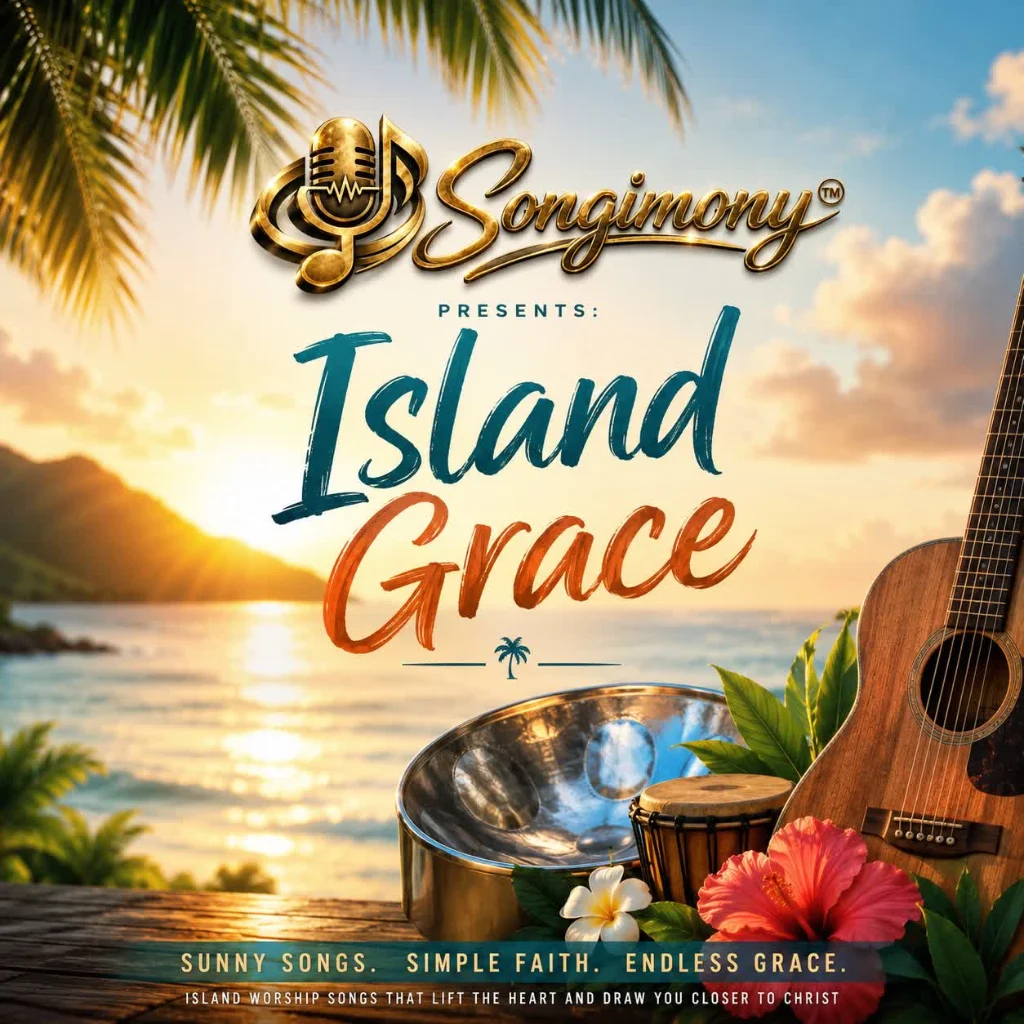
Behind the Music: Island Grace
Where the beauty of the islands becomes a song of faith
There are places in the world where the landscape seems to invite you to slow down.
The ocean moves with a rhythm that doesn’t hurry. Palm trees answer the wind. Mountains disappear into clouds. Sunlight stretches across the water, and evening arrives almost reluctantly, turning the horizon gold, pink, and violet.
Island Grace was created to capture that feeling—and then take it one step deeper.
This album is not simply an album about tropical places. It is an album about what island beauty can make us remember: that life is beautiful, that people need one another, that God is present in the things He has created, and that sometimes faith is experienced most clearly when we finally become quiet enough to notice it.
The album grew from an exploration of Hawaiian and Polynesian musical traditions alongside the broader musical vocabulary of the Caribbean. Those traditions are extraordinarily diverse, and the album does not attempt to claim that one sound represents every island culture. Instead, it draws inspiration from qualities that repeatedly make island music so compelling: organic instruments, memorable melodies, rhythmic movement, vocal harmony, storytelling, and an intimate relationship between music, community, land, and sea.
Why island music?
One of the remarkable things about Hawaiian music is that music has historically been more than entertainment.
The Hawaiian tradition of mele is deeply connected to storytelling, memory, history, people, places, and the land. Traditional chants preserved stories and knowledge through generations. Music could remember a person, describe a place, express love for the land, recount history, or address spiritual subjects.
That idea became important to Island Grace.
The goal was not to put religious lyrics over a generic “tropical” soundtrack. The goal was to allow the musical setting itself to reinforce the message.
That is why the arrangements lean toward ukulele, acoustic guitar, gentle percussion, warm bass, natural vocal harmonies, and spacious production. The music should feel human and organic rather than overly manufactured.
The ukulele became particularly important. Its light, intimate tone immediately creates a sense of warmth and openness. Hawaiian music also developed remarkable guitar traditions, including ki ho’alu, commonly called slack-key guitar, a fingerstyle tradition that originated in Hawai’i.
There is an interesting historical connection here. Hawaiian music itself became a meeting place for cultures. Western string instruments and Christian hymns were introduced to Hawai’i in the nineteenth century and became part of the evolution of Hawaiian musical forms. Hawaiian musicians then made those instruments and musical ideas their own.
That history mattered to this project because Island Grace is also a meeting place: Christian faith, island musical traditions, contemporary pop songwriting, and the universal human experience of finding peace.
The Caribbean connection
The album’s musical palette also draws inspiration from the Caribbean.
Caribbean music has developed through an extraordinary mixture of cultures, histories, languages, instruments, and rhythmic traditions. Reggae, calypso, soca, mento, and numerous other traditions demonstrate how rhythm can become part of identity and community.
The Library of Congress’s documentation of Caribbean music describes the region’s music not simply as entertainment but as an important expression of cultural identity and social life.
That influence can be heard in the album’s relaxed rhythmic feel.
The intention was never to reproduce a specific Caribbean genre. Instead, the album borrows the feeling of movement—the gentle syncopation, the conversational quality of vocals and instruments, the sense that the rhythm should breathe rather than march.
That distinction is important.
Island Grace is island-inspired, not an attempt to imitate a particular culture.
The musical language is a respectful blend designed to evoke warmth, movement, community, ocean air, and spiritual reflection.
“Stay” — When faith becomes a prayer
The album’s spiritual heart begins with a very human request:
Stay.
The song grew from the message of the classic hymn Abide with Me, but rather than simply reproduce the hymn, we wrote an entirely new song around its central emotional idea.
The result is a prayer for God’s presence.
Life changes. People change. Circumstances change. Things we depend upon eventually disappear. The song recognizes that reality without becoming hopeless.
Its message is simple: when the darkness comes, when the road becomes uncertain, when strength begins to disappear, we do not have to face it alone.
The word “stay” became the centerpiece because it is something almost anyone can understand.
A child can say it.
A spouse can say it.
Someone grieving can say it.
Someone struggling with faith can say it.
Someone standing on a beach watching the sun disappear can say it.
The Hawaiian musical setting gives that prayer a different emotional color. Instead of beginning with dramatic orchestration, the song begins with intimacy—ukulele, acoustic textures, space, and a voice.
It feels less like a performance and more like a conversation with God.
“Come Find Your Way Home” — An invitation rather than a sermon
The next idea developed from another beloved hymn, Come unto Jesus.
Again, the purpose was not to rewrite the hymn line by line. The purpose was to take its central invitation and express it in completely original language.
That became “Come Find Your Way Home.”
The song is written for the person who is tired.
For the person who feels lost.
For someone carrying regret.
For someone who has wandered farther than they intended.
And perhaps most importantly, for someone who wonders whether they can still come back.
The chorus deliberately became more radio-oriented. Rather than making the song sound like a traditional hymn, the goal was a memorable phrase that could stay with someone after the song ended.
“Come find your way home.”
That phrase carries two meanings.
There is a physical idea of home—an island, a family, a place where we belong.
And there is a spiritual idea of home—the Savior.
The song therefore becomes an invitation rather than an instruction.
It doesn’t begin with everything someone needs to fix.
It begins with the possibility that they can come home.
“Where Heaven Meets the Sea” — Seeing God in creation
If Stay is the album’s prayer and Come Find Your Way Home is its invitation, “Where Heaven Meets the Sea” is its celebration.
This song was written specifically around the beauty of the islands—the ocean, mountains, palms, sunlight, families, laughter, and evening skies.
But beneath those images is a theological idea:
Creation can point us toward the Creator.
The song looks at the beauty of the islands and asks the listener not merely to admire the scenery, but to recognize the gift behind it.
The ocean becomes more than scenery.
The mountains become more than a backdrop.
The people become more than characters in a vacation photograph.
The beauty becomes an opportunity for gratitude.
That distinction is central to Songimony.
A Songimony song is not simply supposed to tell someone what to believe. It is supposed to create a moment where the listener can feel something, remember something, or see something differently.
In this song, the island itself becomes part of the testimony.
Beauty and belonging
Another important theme throughout Island Grace is people.
Island life is often portrayed through scenery: beaches, sunsets, mountains, palm trees, blue water.
But landscapes don’t create community by themselves.
People do.
The album repeatedly returns to family, friendship, welcome, belonging, shared experiences, and the warmth that exists when people slow down enough to be together.
That is one reason the music emphasizes harmony.
Harmony is more than a production technique.
One voice can carry a melody.
Two or three voices can create something larger than any one of them could create alone.
That makes harmony an especially appropriate musical metaphor for an album concerned with community.
We are not meant to live entirely as solo voices.
We need other people.
We need family.
We need friends.
We need faith communities.
And, ultimately, we need God.
Why the music sounds peaceful
The production philosophy behind Island Grace was intentionally different from the large cinematic approach used in some other Songimony projects.
This album needed room to breathe.
The ukulele provides the heartbeat.
Acoustic guitar provides warmth.
Soft percussion creates movement without overwhelming the listener.
Bass gives the songs their gentle foundation.
Vocal harmonies add the sense of community.
And the arrangements leave enough space for the listener to imagine the ocean, the wind, the sunset, or simply a quiet room.
There is a reason island music can feel peaceful even when it is rhythmically active.
The rhythm does not necessarily demand that you rush.
It invites you to move with it.
That became one of the guiding principles of the album.
Slow down. Listen. Notice.
A bridge between traditions
There is also something historically fitting about combining Christian themes with Hawaiian-inspired musical language.
Christian hymnody became part of Hawaiian musical history during the nineteenth century, when missionaries introduced Western hymns and musical practices. Hawaiian communities did not simply remain passive recipients of those traditions; they incorporated outside musical elements into evolving local forms.
That history reminds us that music is constantly moving.
It crosses oceans.
It meets other cultures.
It is translated into new languages.
It is reshaped by new instruments.
It becomes personal.
Island Grace continues that long process in a contemporary way.
It does not attempt to recreate nineteenth-century Hawaiian music. It does not attempt to recreate traditional Polynesian chant. And it does not attempt to reproduce Caribbean genres exactly.
Instead, it asks what happens when contemporary Christian songwriting meets the emotional vocabulary of island music.
The answer is an album built around warmth, gratitude, invitation, peace, and hope.
The deeper purpose of Island Grace
Ultimately, this album exists because beauty matters.
In a world that can feel increasingly loud, hurried, divided, and complicated, there is value in creating music that gives people permission to breathe.
Island Grace is intended to feel like that moment.
The sun is going down.
The water is moving.
The guitar is quiet.
Someone you love is sitting nearby.
And for a few minutes, nothing needs to be solved.
You simply notice that you are here.
You notice the people around you.
You notice the world God created.
And perhaps, in that quiet moment, you notice God.
That is the grace at the center of the album.
Not perfection.
Not escape.
Presence.
The grace to slow down.
The grace to come home.
The grace to ask God to stay.
The grace to recognize beauty.
And the grace to understand that sometimes the most profound spiritual experiences do not arrive with thunder.
Sometimes they arrive with a breeze, a melody, a familiar voice, and the sound of waves reaching the shore.
That is Island Grace.