
Harbor Lights —
The Covenant Path
There are albums that tell a story, and there are albums that invite the listener to recognize their own story inside the music.
The Covenant Path by Harbor Lights was created to do the latter.
The album was conceived as a musical journey through the progression of a disciple’s life—not as a collection of unrelated religious songs, but as ten connected moments of testimony. Each song explores a different principle of the gospel, while the sequence allows one principle to naturally lead into the next.
The result is an album about becoming.
It begins with a person discovering faith and ends with a person seeking to live a consecrated, covenant-centered life. Between those two points are moments of change, commitment, guidance, responsibility, obedience, sacrifice, gospel living, consecration, and personal holiness.
The album exists because these principles are often taught individually. The Covenant Path asks a different question:
What happens when we hear them as one journey?
A Journey Rather Than a Devotional
One of the earliest creative decisions was to make the album a testimony journey rather than a traditional devotional collection.
A devotional song can communicate a truth directly. A journey can allow the listener to experience that truth through a developing story.
The narrator of The Covenant Path isn’t presented as someone who has everything figured out. Instead, the songs move through discovery and decision. Faith leads to repentance. Repentance leads to baptism. Baptism leads to the companionship of the Holy Ghost. That companionship leads to greater understanding of priesthood and service. Obedience becomes more meaningful as the disciple learns to sacrifice. Gospel living expands into consecration, and the journey ultimately calls for purity and covenant fidelity.
The listener is therefore not simply being told what to believe.
The listener is walking somewhere.
The Ten-Part Structure
The album follows a deliberate ten-song progression:
1. Faith — I Will Follow His Light The journey begins with trust: believing that God knows us, has a purpose for us, and can lead us even when we cannot see the entire road.
2. Repentance — Turn My Heart Again Faith becomes personal when the individual recognizes the need to change. Repentance is portrayed not simply as regret, but as turning home.
3. Baptism — Made Clean in the Water The journey moves from intention to covenant. Baptism becomes the outward expression of an inward decision to follow Christ.
4. Gift of the Holy Ghost — Lead Me in Your Voice After making a covenant, the disciple does not walk alone. The story turns toward spiritual guidance, quiet prompting, peace, and the ability to recognize divine direction.
5. Priesthood — Called to Serve The journey now moves beyond the individual. Priesthood is presented through the lens of sacred responsibility and service—using God’s authority to bless others rather than as a position of status.
6. Obedience — I Will Walk Your Way Spiritual direction becomes daily action. The disciple learns that covenant living is expressed through thousands of ordinary choices.
7. Law of Sacrifice — What I Lay Down The journey becomes more demanding. Faith and obedience eventually require surrender—letting go of personal desires, comfort, pride, or plans in favor of something greater.
8. Law of the Gospel — Walk With Him Today The gospel is no longer simply something the narrator believes or practices at specific moments. It becomes a way of life centered on Jesus Christ.
9. Law of Consecration — All That I Am The question moves from What am I willing to give? to What belongs to God in the first place? The song explores the surrender of one’s time, gifts, plans, possessions, and entire self.
10. Law of Chastity — Set Apart for You The journey closes with personal holiness and covenant fidelity. The emphasis is not merely on avoiding transgression, but on becoming a person whose heart, relationships, and choices are deliberately set apart for God.
The progression is intentional.
Each song creates the spiritual question that makes the next song possible.
Why This Musical Style?
The music was deliberately chosen to avoid making the album sound like a conventional collection of worship recordings.
Harbor Lights was given a recognizable musical identity built around warm 1990s adult contemporary pop with soulful blues influence. Acoustic guitar, clean electric guitar, mellow bass, brushed drums, subtle keyboard textures, and restrained production create a sound that feels familiar without being tied to a particular contemporary worship trend.
That choice was important.
The goal was to make the music feel personal before it feels institutional.
The songs are intended to sound like something a person might listen to while driving home, sitting alone on the coast, reflecting after a difficult day, or thinking about the direction of their life.
The blues influence adds another dimension. Blues naturally carries the vocabulary of struggle, imperfection, longing, and redemption. Those qualities fit the testimony journey particularly well. The narrator isn’t celebrating a perfect life. He is learning how to walk a covenant path through an imperfect one.
The 90s adult-contemporary influence also gives Harbor Lights a consistent sonic fingerprint. Across ten songs, the instrumentation and vocal character remain recognizable enough to establish an artist identity, while the individual arrangements can change according to the story each song is telling.
The Importance of the Voice
Harbor Lights was designed as more than a name attached to ten recordings.
The project uses a consistent fictional male artist identity: warm, intimate, slightly raspy, emotionally restrained, and sincere. The vocal isn’t intended to sound like a choir, preacher, or theatrical worship leader.
It is meant to sound like one man telling the truth about what he has learned.
That distinction supports the album’s central idea.
The songs aren’t presented as declarations from someone standing above the listener. They are reflections from someone walking the same road.
Why These Topics?
The ten subjects were selected because together they describe a progression of covenant discipleship.
Faith introduces trust.
Repentance introduces change.
Baptism introduces covenant.
The Holy Ghost introduces continuing guidance.
Priesthood introduces sacred service and responsibility.
Obedience introduces daily commitment.
Sacrifice introduces surrender.
The law of the gospel introduces a Christ-centered way of living.
Consecration introduces complete dedication.
Chastity introduces personal holiness and covenant fidelity.
Taken individually, each topic can seem like a separate lesson.
Taken together, they tell a much larger story:
God is not simply asking us to know something. He is inviting us to become something.
That is the central creative premise of The Covenant Path.
A Record Designed to Be Heard in Sequence
Although each song is intended to stand on its own, the album is strongest when experienced from beginning to end.
The early songs are more intimate and exploratory. As the journey develops, the narrator becomes increasingly deliberate. The emotional center of the album arrives around sacrifice and consecration, where the listener encounters the question of what it really means to give one’s life to God.
The final songs then turn inward again.
After everything the narrator has learned about covenants, service, obedience, sacrifice, and consecration, the journey ultimately reaches the character of the individual.
The path isn’t merely about where we are going.
It is about who we are becoming while we travel it.
Why Harbor Lights?
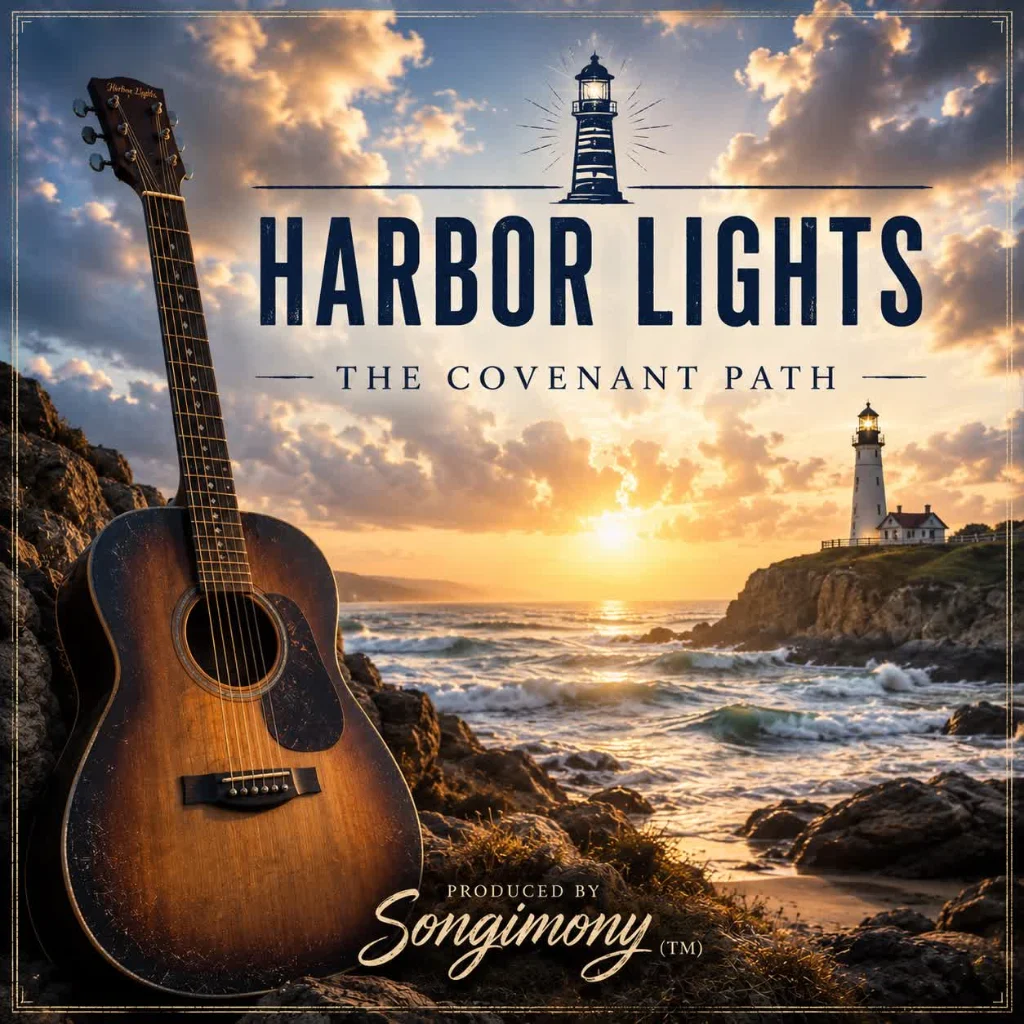
The name Harbor Lights was chosen to complement the album’s imagery.
A harbor light doesn’t make the journey for a sailor. It doesn’t remove the waves or guarantee calm seas.
It simply provides a point of reference.
A light in the distance can tell someone where they are, where safety lies, and which direction to travel.
That metaphor became the musical identity of the project.
The songs of The Covenant Path are not intended to suggest that discipleship eliminates uncertainty, hardship, temptation, sacrifice, or failure. Instead, they point toward the light that helps a person continue when the entire path cannot yet be seen.
The album artwork carries that same idea: the guitar representing the human voice and personal testimony, the ocean representing the journey, the lighthouse representing direction, and the expansive sky suggesting something larger than the individual.
There are no shortcuts represented.
There is simply a path, a light, and the decision to keep walking.
The Purpose of the Album
Ultimately, The Covenant Path was created to give listeners a musical way to reflect on their own covenant journey.
Someone may hear I Will Follow His Light and remember the first time faith became real.
Another listener may hear Turn My Heart Again and recognize a season of repentance.
Made Clean in the Water may bring memories of baptism.
Lead Me in Your Voice may sound like the quiet realization that spiritual guidance often comes differently than expected.
Other songs may prompt reflection on service, obedience, sacrifice, consecration, or personal holiness.
The album doesn’t require every listener to be in the same place.
That is part of its purpose.
The covenant path is experienced one step at a time.
And perhaps that is why the final message of the album isn’t simply about reaching a destination.
It is about continuing to walk.
Faithfully.
Personally.
One covenant, one choice, and one step at a time.
The Covenant Path is Harbor Lights’ musical invitation to do exactly that.