
Behind the Music
Some albums begin with a musical idea. This one began with a feeling.
There are questions that sit underneath almost everything we experience: Where did I come from? Why am I here? Why does life have to be difficult? What happens when it ends? And if there is more beyond this life, what does that mean for the way I live this one?
Lawrence Fisher wanted to explore those questions.
Within the album there is a beautiful framework for understanding those questions. A belief that existence did not begin at birth. Where agency, opposition, relationships, choices, mistakes, growth, and experience become part of what we are becoming. Death is not viewed as disappearance, but as a transition, with continued existence beyond mortality and the promise of a life beyond the grave.
Those ideas are foundational to this collection, but Lawrence didn’t want to simply explain them. He wanted to turn them into songs people could feel before they understood them.
That became the creative challenge.
Rather than filling the lyrics with religious vocabulary, Lawrence looked for ordinary places, objects, decisions, memories, rooms, roads, doors, weight, darkness, light, and the strange moments when something familiar suddenly feels larger than itself. The symbolism is there, but the songs don’t stop to explain it. They leave room for the listener to discover it.
He also wanted to make this album more personal than other song lyrics he has written. In an effort to bring the project closer to the artist and the audience, this album carries Lawrence Fisher’s actual voice throughout the entire record. With the help of production tools to produce the assisted back up and chorus vocals, Lawrence can guide listeners while they experience this journey together. That decision was designed to change the character of the album. These aren’t simply songs being performed by a voice chosen to fit the production. They are being delivered in his own voice, which makes the questions more personal and the journey more intimate.
The album isn’t really about having all the answers.
It is about living inside the questions.
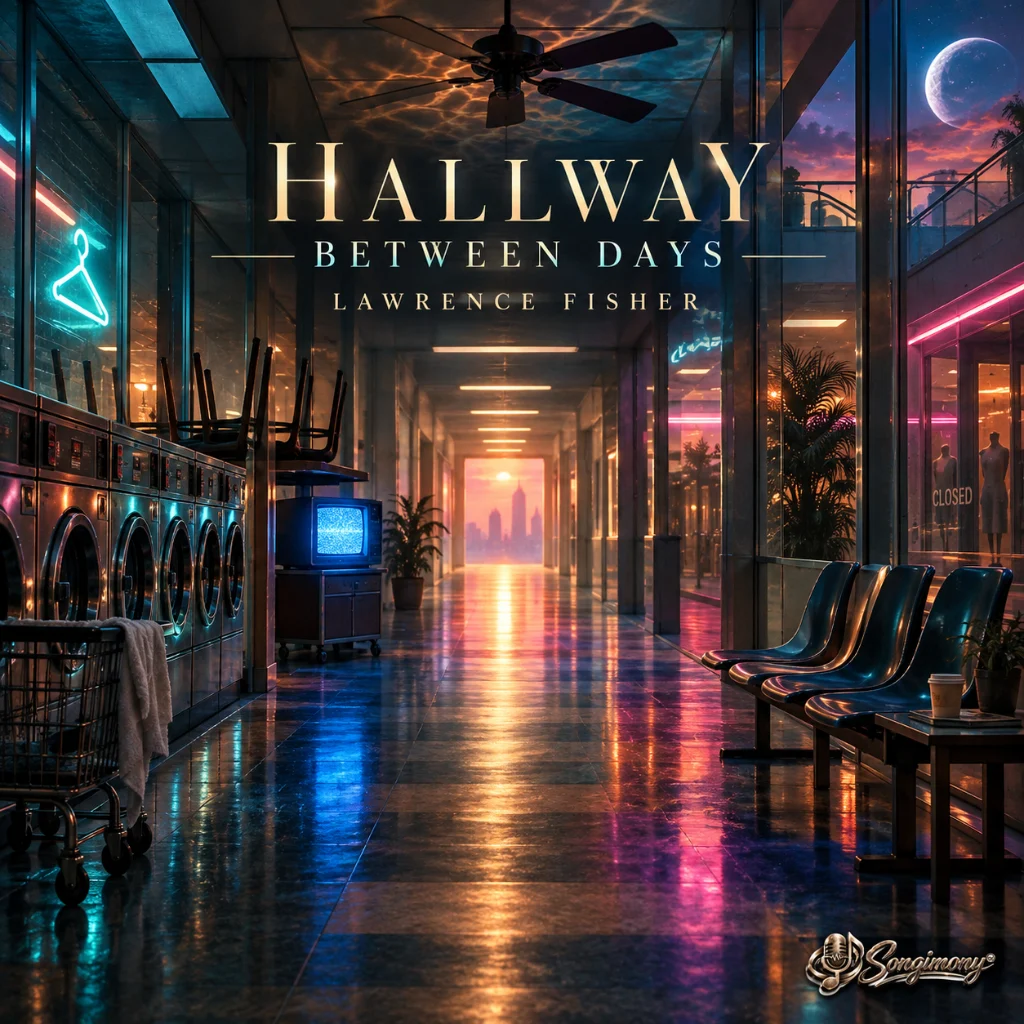
The title Hallway Between Days came from that feeling of existing somewhere between what we know and what we don’t. The first song, “Hallway Between Days,” became a kind of doorway into the entire collection. Its disconnected scenes—a laundromat after closing, chairs stacked in a waiting room, a mall after sunset, an empty pool, a late bus—aren’t meant to form a conventional story. They are fragments of a place that feels recognizable without being completely explainable.
That became one of the guiding principles for the album.
The songs don’t all tell stories. Some do. Some are built around an image. Some are questions. Some are moments of realization. Some deliberately leave the listener standing in the middle of something without telling them exactly what it means.
Together, however, they move through a larger human experience: remembering something before this life, arriving here with the freedom to choose, discovering the weight of mortality, becoming through experience, confronting what we have broken, discovering that we don’t have to carry everything alone, finding a way back, facing death, awakening beyond it, and asking what part of us ultimately remains.
The music was built with that same philosophy.
The album draws from cinematic indie-pop and neo-psychedelic textures, combining intimate vocals with deep bass, atmospheric synths, restrained guitars, electric piano, evolving percussion, tape character, spacious reverbs, and moments of controlled expansion. But the production was deliberately not made to sound like twelve versions of the same song. Each track was given its own opening, instrumental identity, rhythmic character, and emotional movement while maintaining a shared sonic world.
Even the beginnings of the songs were treated differently. Rather than relying on the same guitar-strumming or arpeggiated introduction, each song was given permission to enter through a different doorway—a texture, a piano figure, an isolated note, a pulse, an atmospheric sound, or a sparse instrumental phrase. The goal was for every song to feel like it had arrived from somewhere slightly different, while still belonging to the same journey.
And that journey unfolds through the songs themselves.
1. “Hallway Between Days”
The opening song establishes the central feeling of the album: being somewhere between one thing and another. The laundromat, waiting room, empty mall, pool, and late bus aren’t explanations of mortality. They are places that feel temporarily suspended, places where normal life has stopped moving.
The repeated line, “I live in the in-between,” becomes the emotional center.
Earth life can feel like that—a temporary passage between what came before and what comes after.
2. “Somewhere I Remember”
This song reaches backward.
The photograph, the unfamiliar faces that somehow feel familiar, and the dream of a place without a ceiling create the suggestion of a memory that cannot quite be recovered.
It explores the idea of preexistence without ever naming it. The narrator doesn’t suddenly remember a previous life in detail. Instead, there is a feeling of recognition beneath the noise of the present.
That uncertainty is intentional.
The song asks what it might feel like to have come from somewhere we cannot consciously remember.
3. “No One Told Me Which Way”
If “Somewhere I Remember” looks backward, this song looks directly at agency.
The road divides. There is no voice telling the narrator which direction to take. The map is incomplete. The compass doesn’t solve the problem.
The important moment isn’t discovering the correct road.
It’s choosing.
That reflects one of the central ideas of earth life: people are given the ability to make meaningful choices rather than simply being carried through an existence that has already been decided for them.
4. “The Weight of Things”
Here mortality becomes physical.
Gravity, falling, bruises, broken hearts, goodbyes, and the ground beneath our feet all become ways of describing the weight of being alive.
The song turns that weight into something more than a burden. Pain, limitation, opposition, and consequence become part of the experience through which a person learns what matters and discovers the capacity to rise.
The question underneath the song is simple:
If nothing ever pulled us down, would we ever learn how to rise?
5. “Unfinished”
“Unfinished” moves from experiencing life to becoming through it.
The pencil mark on the doorway, the unfinished letter, the old photograph, and the growing tree all point toward the same idea: people aren’t supposed to arrive in mortality already complete.
Earth life is developmental.
People learn. They change. They fail. They discover new rooms inside themselves. They become something they could not have become without the experience.
The song doesn’t treat being unfinished as a defect.
It treats it as part of the purpose.
6. “What I Can’t Undo”
Eventually the album must confront choice from another direction.
Some choices leave damage behind.
The unsent message becomes a symbol for regretting the things people wish they could pull back, the words they wish they could remove from the air, the moments they cannot put back where they were.
But the song refuses to end with regret.
“Maybe tomorrow can still be changed.”
That becomes the beginning of accountability, change, and the possibility of becoming different from the person who made the mistake.
7. “The Other Side”
This song changes the perspective again.
The narrator is sitting on the stairs, overwhelmed by something too heavy to carry alone. Then someone takes the other side.
The symbolism here points toward the role of Jesus Christ and the Atonement without turning the song into a doctrinal explanation. The important experience is not being told that the burden isn’t heavy.
It is discovering that it doesn’t have to be carried alone.
The song is about grace, experienced rather than explained.
8. “The House I Left”
If “What I Can’t Undo” deals with what people have done, “The House I Left” deals with what happens when they decide to return.
The house becomes a symbol of home, belonging, and reconciliation. The narrator expects to have to explain himself or earn his way back.
Instead, the door is already open.
The song explores repentance not as humiliation, but as movement—turning around, taking the first step, and discovering that returning is still possible.
9. “The Blue Door”
The blue door takes that idea one step further.
This time, the narrator doesn’t simply return to something that was waiting for him. He has to repair something he damaged.
He sands the wood. Repairs the hinges. Leaves the scar beneath the paint.
That detail matters.
Restoration doesn’t mean pretending the damage never happened. It means becoming strong enough to open again.
The final image—someone walking through the repaired door while the narrator leaves it open—turns forgiveness into something active.
10. “Not the End of the Light”
Now the album crosses the boundary of death.
The song deliberately avoids treating death as disappearance. A star can move beyond our sight and still be burning. The shoreline can disappear into darkness without the sea disappearing with it.
The central idea is that absence is not necessarily nonexistence.
For an LDS understanding of life after death, that distinction is important. Death changes a person’s relationship to someone; it does not erase the existence of the person.
11. “When I Wake”
After death comes awakening.
This song is intentionally written as a series of questions. What will people remember? What will make sense? Will they understand things they could not understand here?
The language of waking becomes a way to approach resurrection without turning the song into a theological lecture.
The narrator doesn’t claim to know every detail.
He simply believes there is a morning beyond this night.
12. “What Remains”
The album closes with the question that has been underneath everything from the beginning:
What actually lasts?
Not the body. Not the years. Not possessions. Not the things that disappear with time.
What remains are the things that reached beyond the limits of a single life—the love people gave, the people they changed, the identity beneath mortality, and whatever part of them cannot be contained by time.
The final line, “Something does,” deliberately leaves the door open.
The album doesn’t need to explain eternity in order to point toward it.
Why This Album Exists
Lawrence Fisher didn’t want to make twelve songs that explained a belief system.
He wanted to make twelve songs that allowed someone to walk through it.
The progression from pre-earth life to earth life, from agency to opposition, from mistakes to restoration, from mortality to death, and from death toward resurrection and continued existence is there beneath the surface. But the listener doesn’t have to know that framework to understand the songs.
They can simply hear a person standing in a hallway.
Someone looking at an old picture.
Someone choosing a road.
Someone learning what gravity feels like.
Someone realizing they are unfinished.
Someone sitting beside what they cannot undo.
Someone discovering that another person will carry the other side.
Someone returning home.
Someone repairing a blue door.
Someone standing in the dark and realizing the light has not disappeared.
Someone waiting to wake.
Someone asking what remains.
That is what Lawrence wanted Hallway Between Days to become.
Not a lesson.
Not an explanation.
A musical reflection on what it means to be here and the possibility that being here is only one part of a much larger story.