
Janice Orr
Seven Songs for a Life That Kept Giving
Some lives are difficult to preserve in a single song.
Not because there is too much biography to fit into three or four minutes, but because the people who knew them remember them in different ways.
At Janice Orr’s celebration of life, those differences became part of the portrait.
Her sister remembered the girl she had grown up beside her. The big sister who cared for her, told her stories, rode her to school, learned, performed, worked and kept reaching for more.
Her daughter remembered a mother who filled a home with books, music, poetry, cultural experiences, expectations, service and learning.
Her son remembered recurring themes that seemed to run through his mother’s entire life: service, independence, education and the arts.
And her grandson found another word.
Stayed.
“She stayed.”
The memories did not suggest one simple memorial song. They revealed several different ways of understanding the same woman.
So Songimony created four original songs from those memories.
But Janice’s funeral had its own music too.
Three songs were performed that day: Each Life That Touches Ours for Good, I Feel My Savior’s Love, and Amazing Grace on bagpipes.
Rather than separate the funeral music from the Songimonies it inspired, the seven songs now belong together—part family memory, part testimony, part farewell.
Each Life That Touches Ours for Good
The collection begins where Janice’s celebration of life began.
Each Life That Touches Ours for Good was the opening hymn at her funeral.
It creates the right doorway into her story.
Before remembering what Janice accomplished or trying to define her character, there is first the recognition that a life is known by the people it touches.
Janice was remembered as a sister, wife, mother, grandmother, teacher, friend and servant.
Her sister remembered the older girl who looked after her and helped make childhood feel safe.
Her children remembered a mother who expected them to learn, work, serve and develop their abilities.
Her grandchildren knew someone who remained invested in the people they were becoming.
The hymn therefore does more than reopen the funeral.
It introduces the central truth behind the entire collection:
Janice’s life was not lived in isolation.
It moved outward into other people.
Do the Hard Things First
Among the most valuable material preserved at the funeral were Janice’s own words.
Her sister Madalyn explained that portions of her remarks came from histories and writings Janice had left behind. Among them was a simple philosophy:
“I believed in doing the hard things first because that made the rest easier.”
It sounds like Janice.
Her son spoke of a mother who valued independence and education. Her daughter remembered someone organized, dependable, knowledgeable and continually learning. There were expectations in the Orr family. Opportunities were meant to be used. Talents were meant to be developed. People were expected to become capable.
Do the Hard Things First preserves that strength.
It also asks a question that often becomes clearer only with age: what if some of the expectations we experienced as children were another way a parent was saying, I believe you are capable of more?
The song does not soften Janice into a generic memorial figure.
It lets her remain strong.
Because strength was part of the story.
What She Gave Away
Steven Orr described his mother’s idea of service very practically.
Service might mean giving someone time, effort, money or advice.
“My dad folded chairs, and my mom gave food,” he remembered.
Christi remembered seeing dessert prepared in their home and wondering who it would be delivered to that day.
Those are small details.
That is precisely why they matter.
Generosity often survives in family memory not as an abstract virtue, but as a plate leaving the kitchen, something sewn for another person, a lesson patiently taught, a problem organized, or help arriving because somebody noticed it was needed.
Christi also shared words attributed directly to Janice:
“I tried to teach people to fish, rather than fish for them.”
That distinction became central to What She Gave Away.
Janice did not only want to help people.
She wanted them to become capable.
That made her service an extension of the same independence she expected from herself and encouraged in her family.
The song asks us to see generosity differently: perhaps what a person gives away is not actually lost.
Sometimes it returns as a stronger person.
Sometimes it becomes a family habit.
Sometimes, years later, somebody else carries the plate out the door.
I Feel My Savior’s Love
At the center of the collection is a song that was not written about Janice, but was chosen to be part of the day her family gathered to remember her.
I Feel My Savior’s Love was performed during the funeral.
Its place here matters because faith appears repeatedly in the way Janice’s family spoke about her.
Her sister described Janice’s love for Jesus Christ and the sustaining influence of the gospel in their family.
Her daughter remembered years of Church and temple service.
Her bishop remembered Janice as both strong and compassionate and connected those qualities, from his perspective, to her relationship with the Savior.
Rather than forcing every original Songimony to carry all of that spiritual meaning, I Feel My Savior’s Love is allowed to stand at the center and carry something the family had already chosen to express through music.
It becomes a pause between the outward life of service and the more interior things Janice valued.
Strength.
Service.
Faith.
And then beauty.
I Love the Arts
The next song may contain the most distinctly Janice idea of the collection.
In material identified by her sister as Janice’s own writing, Janice said:
“I love the arts.”
She believed participating in them “made life easier to live.”
Her family supplied the evidence.
Broadway recordings played over Sunday dinner.
Children took music lessons and attended concerts and musical plays.
Poetry was memorized—sometimes with an incentive.
There were recitations, theater, dancing, sewing, performances and books.
Steven remembered his mother’s love of theater, art and dancing and how she supported his own involvement in performance.
For Janice, art does not appear to have been ornamental.
It was useful.
It helped people live.
That belief gives I Love the Arts an unusual meaning now.
A family gathered because Janice was gone.
They told stories.
They recited poetry.
They performed music.
And now those memories have become songs.
In a way, the act of preserving Janice through music demonstrates the very idea she left behind.
Art cannot undo loss.
But it can give grief somewhere to go.
It can hold a voice after the room becomes quiet.
It can turn a remembered sentence into something a great-grandchild may someday hear.
It can make a difficult thing a little easier to carry.
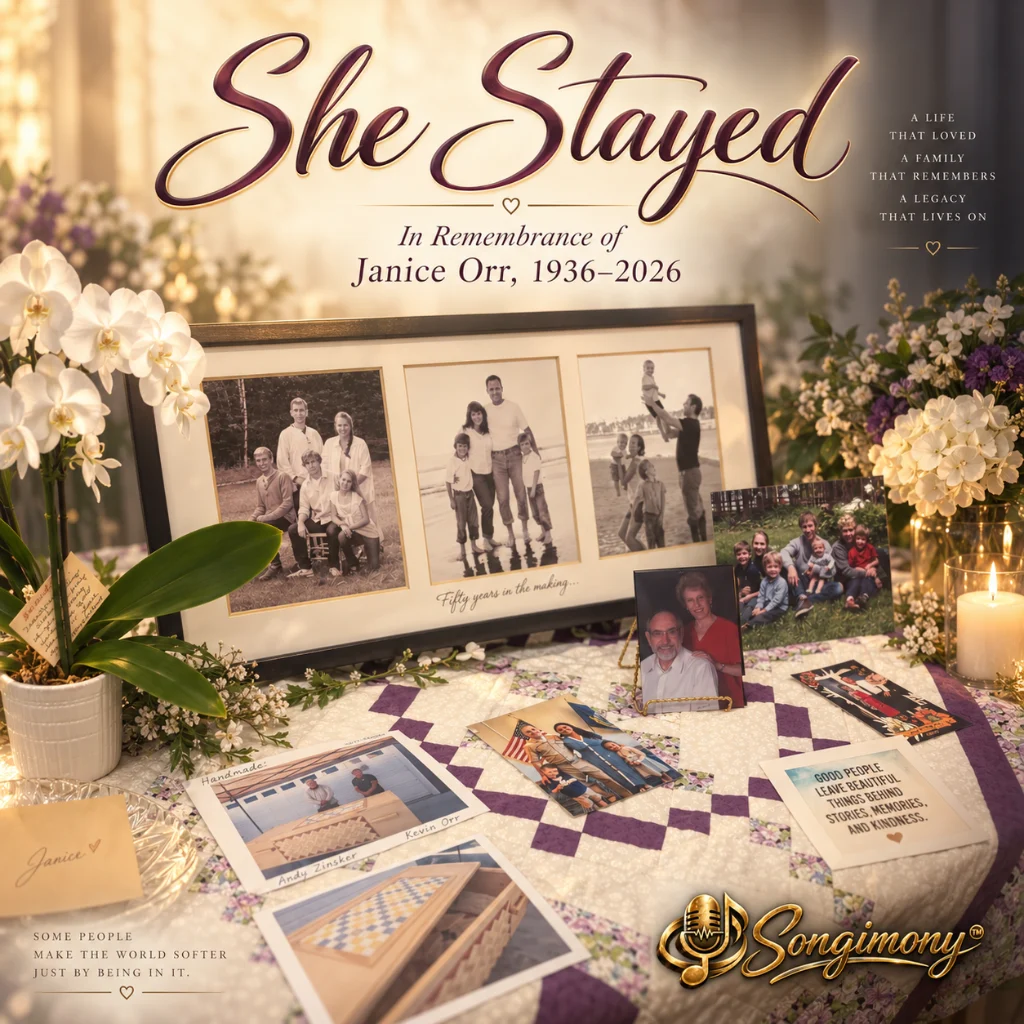
She Stayed
Daniel’s remembrance of his grandmother was built around something remarkably ordinary.
Janice stayed.
She stayed when there was work left to finish. She stayed to bag leftovers and make sure the chairs were put away. She stayed with the people she loved. She stayed through difficulty. She stayed in her faith.
But Daniel was not simply remembering that quality in his grandmother.
He was being asked to live it.
Daniel is a full time missionary for The Church of Jesus Christ of Latter-Day Saints nearing the end of his two year mission when Janice died. He had a ticket home, and he could have returned early to attend her funeral. Instead, he made the difficult decision to remain and finish what he had gone there to do.
His tribute became a promise:
“Grandma, I’m going to stay.”
“I’m going to finish what I started.”
“I’ll finish my mission.”
He could not be in the room to say goodbye to his grandmother.
Instead, he honored her by doing what he believed she had taught him to do.
He stayed.
That changes She Stayed from a song simply describing Janice into a story about legacy happening in real time.
Janice’s example had already crossed generations.
Her grandson was faced with the choice to leave something unfinished or remain when staying was difficult.
He chose to stay.
That is how legacy works.
Not only through names, dates, photographs, or stories—but when something a person taught by the way they lived becomes part of how another person chooses to live.
Amazing Grace — Bagpipes
The final song does not need to explain Janice.
It simply needs to say goodbye.
Amazing Grace was performed on bagpipes at her funeral.
Placed at the end of this collection, it returns the listener to the actual memorial after traveling through Janice’s character, service, faith, love of the arts and legacy.
There is something fitting about allowing an instrumental farewell to have the final word.
After She Stayed, there is nothing left that needs to be argued.
Her family has remembered her.
Her grandson has answered her life with a promise of his own.
The songs have carried what words could carry.
Then the bagpipes can do what music sometimes does better than language.
They can let the room grow quiet.
More Than a Funeral
The purpose of these seven songs is not simply to document that Janice Orr died.
They are meant to preserve something more difficult:
who she was while she was here.
A woman who expected people to become capable.
A woman who served in practical ways.
A woman who believed learning mattered.
A woman who filled life with music, poetry, theater, sewing, travel and experience.
A woman whose faith helped shape the way she lived.
A woman whose family remembers that she stayed.
The four original Songimonies do not attempt to fit every year, place, accomplishment or family story into lyrics.
And the three songs from Janice’s funeral do not simply fill space between them.
Together, they tell the story from different directions.
Each Life That Touches Ours for Good remembers the lives connected to hers.
Do the Hard Things First preserves her strength.
What She Gave Away remembers how she served.
I Feel My Savior’s Love preserves the faith that surrounded her life and funeral.
I Love the Arts carries one of her own clearest philosophies.
She Stayed passes her example forward to another generation.
And Amazing Grace becomes the farewell.
Decades from now, someone in the family may encounter these songs without ever having known Janice.
They may not remember the funeral.
They may never have sat at her table.
They may never have heard her recite a poem or felt the force of one of her expectations.
But perhaps they will understand something real about her.
And perhaps, when their own life becomes difficult, they will hear something passed down through the family:
Finish what you started.
Help somebody stand.
Keep your faith.
Make something beautiful.
Stay.