
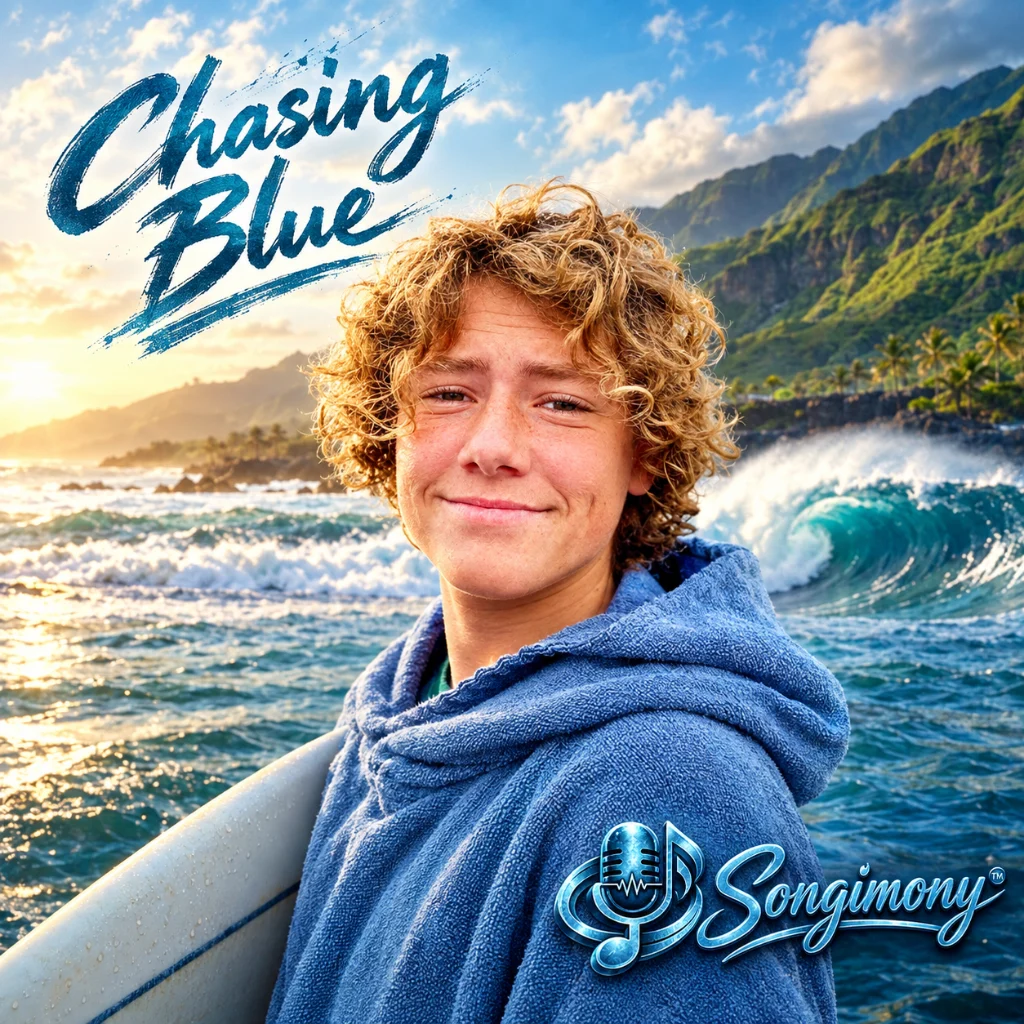
12 Waves. 12 Places. 12 Voices. 12 Sounds. One Journey.
There are albums that tell a story.
And then there are albums that take you somewhere.
Chasing Blue was created to do both.
The idea began with a simple question: What if a surf album didn’t just sound like surfing, but actually traveled?
Not every surf break sounds the same. Not every coastline feels the same. The people are different. The languages are different. The weather is different. The rhythm of life is different. Even the way a wave moves across a reef, point, river mouth or sandbar changes the emotional character of the place.
So instead of making twelve variations of the same surf song, Songimony built an album around a much bigger experiment:
Twelve famous surf destinations. Twelve distinct musical identities. Twelve regional English vocal identities. One continuous human story.
The result is Chasing Blue.
The Idea Behind the Journey
At first glance, this is an album about surfing.
Underneath, it is about something much more universal.
We think we’re chasing waves.
But really, we’re chasing moments worth remembering.
A wave lasts seconds. A trip lasts days. A friendship can last decades. A place can change us without us realizing it. And eventually, the thing we thought we were pursuing turns out to have been carrying us somewhere else entirely.
That became the quiet emotional spine of the album:
creation, wonder, connection, humility, joy, love, hospitality, friendship, mortality, peace, perseverance and gratitude.
These ideas are allowed to live inside ordinary human experiences:
A sunrise.
A frightening wave.
A friend laughing.
Someone making room for a stranger.
A person we fall in love with.
A place that humbles us.
A day when the ocean doesn’t cooperate.
The realization that we’re getting older.
The patience to wait.
The courage to paddle back out.
And finally, the recognition that home was waiting for us all along.
One Ocean, Twelve Worlds
The album deliberately moves around the globe, but the locations aren’t simply postcards.
Each destination changes the music.
Each location changes the narrator.
And each song advances the story.
1. Malibu — The Beginning
The journey begins where the idea of the journey itself feels natural: Malibu.
Malibu is dawn, PCH, a board in the car, a friend beside you and the feeling that the entire day is still ahead.
Musically, it establishes the album’s California surf-rock foundation—dreamy, psychedelic, warm and hypnotic.
But it also introduces something that will quietly travel through every song: the four-note guitar motif.
That motif is the musical thread connecting twelve very different worlds.
In Malibu, it sounds like possibility.
The narrator doesn’t know where the day will go.
He simply knows he’s going.
And the album begins.
2. Pipeline — Humility
Pipeline changes everything.
The relaxed California confidence of the opening track is replaced by power, danger and uncertainty. The North Shore’s Banzai Pipeline is famous for powerful barreling waves over shallow reef, and the song intentionally treats the ocean as something that cannot be conquered.
The music becomes heavier.
The drums become larger.
The guitars become darker.
The narrator goes from “Let’s see what we can catch” to confronting something much bigger than himself.
The lesson isn’t victory.
It’s humility.
You don’t beat a wave.
You learn its way.
And sometimes the greatest achievement is simply being grateful that the ocean allowed you through.
3. Negril — Joy
Negril deliberately slows the journey down.
This song was also an exercise in authenticity. Rather than pretending Negril is another Pipeline, the story is intentionally modest: a small swell, warm water, friends, music and a good day. Negril is celebrated for its laid-back atmosphere, Seven Mile Beach and sunsets.
The music moves into reggae, rocksteady and surf territory.
The lesson is simple:
Joy doesn’t always require something extraordinary.
Sometimes the smallest wave becomes the best memory because of who was standing beside you.
4. Snapper Rocks — Friendship
The journey gets faster.
Snapper Rocks and the Superbank provide a natural musical transition into energetic Australian indie surf rock. The Superbank stretches from Snapper through Rainbow Bay, Greenmount, Coolangatta and toward Kirra, creating the long-running wave that inspired the song’s sense of speed.
But the real subject isn’t speed.
It’s mateship.
The jokes.
The hooting from the shoulder.
The exaggerated stories afterward.
The feeling that someday, when the waves are long gone, those are the details everyone will remember.
The four-note motif becomes faster here, almost racing down the line with the wave.
5. Rincón — Love
Rincón changes the emotional vocabulary.
The Caribbean atmosphere, Puerto Rican cadence and Latin rhythmic influence create something warmer and more intimate.
The song isn’t really about finding the perfect wave.
It’s about finding someone.
Rincón is a major surfing destination in western Puerto Rico, with breaks including Tres Palmas, María, Sandy and Domes, and it is equally known for its sunsets and relaxed atmosphere.
The music therefore becomes romantic without becoming conventional Latin pop.
The narrator begins the album chasing places.
Here, he starts realizing that people may matter more than places.
6. Teahupoʻo — Awe
Teahupoʻo is the album’s confrontation with sheer scale.
Tahiti Tourisme describes Teahupoʻo as a world-famous, powerful left-breaking wave at the end of Tahiti’s peninsula.
The song therefore had to sound enormous.
Huge drums.
Deep bass.
Distorted surf guitars.
Atmospheric guitars.
A swirling instrumental section that feels like being inside the barrel.
But beneath all that power is a quiet realization:
Some places don’t need to be explained. They simply make you feel small.
The narrator doesn’t conquer Teahupoʻo.
He disappears inside it.
And comes back changed.
7. Uluwatu — Openness
Uluwatu is where the album gets lost on purpose.
The narrator takes a wrong turn.
He meets people.
He encounters a culture he doesn’t fully understand.
And instead of trying to control the experience, he becomes open to it.
Uluwatu is one of Bali’s defining surf destinations, with multiple reef breaks, cliffs and the cultural presence of the temple above the ocean.
Musically, the song becomes psychedelic and slightly mysterious, incorporating Indonesian-inspired textures without turning the track into generic “world music.”
The message is simple:
Sometimes you find your way by allowing yourself to get lost.
8. Cloudbreak — Hospitality
Cloudbreak expands the album again.
The ocean becomes enormous.
The guitars become spacious.
The vocal becomes warm and communal.
Cloudbreak is a legendary left-hand reef break in Fiji’s Mamanuca Islands, accessible by boat and known for long, powerful barrels.
But the song isn’t ultimately about the wave.
It’s about the person who says:
“Bula.”
The person who points toward the lineup.
The person who makes room.
The person who turns a traveler into a guest.
The emotional discovery is that belonging doesn’t always begin with knowing someone.
Sometimes it begins with someone welcoming you.
9. Jeffreys Bay — Time
Jeffreys Bay introduces something the earlier songs haven’t confronted directly:
time.
The wave doesn’t know how old the surfer is.
It doesn’t care about birthdays.
It doesn’t remember yesterday.
It simply keeps moving.
The music becomes one of the album’s fastest and most driving arrangements, reflecting the speed of Supertubes while the lyrics quietly recognize that the narrator is aging.
Jeffreys Bay’s tourism organization identifies Supertubes as its signature world-class surf break and emphasizes both surfing and the town’s coastal character.
The revelation isn’t despair.
It’s gratitude.
The years are passing.
But there’s still another wave coming.
So paddle out.
10. Mundaka — Peace
After Jeffreys Bay, the album needs to breathe.
Mundaka does exactly that.
Rain.
A river.
A harbor.
Gray hills.
Waiting.
Mundaka’s famous left forms at the mouth of the Gernika estuary, and the Basque tourism authorities recognize the village as a globally known surf destination.
The music becomes slower, modal and atmospheric.
The lesson is patience.
Not every day goes according to plan.
Not every wave arrives when you want it.
And sometimes the most important thing you can do is stop chasing.
Be here now.
11. Supertubos — Perseverance
The final overseas chapter brings the energy back.
Portugal’s Supertubos is known for powerful, tubular beach-break waves, and Peniche has built an international surf identity around its collection of breaks.
But this song isn’t about triumph.
The narrator misses waves.
Gets caught inside.
Gets knocked around.
Laughs.
Paddles back out.
And eventually gets the ride.
That distinction matters.
Acceptance isn’t surrender.
You can accept what you cannot control and still continue showing up.
The album’s four-note motif becomes urgent here—a musical representation of perseverance.
“One more wave before I go.”
12. Trestles — Gratitude
And then we come home.
Trestles was intentionally chosen as the final destination because it could answer Malibu.
The album began in Southern California.
It travels around the world.
And it returns to Southern California carrying everything it learned.
Trestles is part of the San Onofre coastline and is one of the world’s best-known surfing destinations.
But the final song isn’t simply nostalgia.
It is recognition.
The narrator realizes that every place mattered.
Every wave mattered.
Every person mattered.
The frightening waves.
The funny mornings.
The strangers.
The friends.
The person he fell in love with.
The years passing.
The days that didn’t go according to plan.
The waves he missed.
The waves he caught.
All of it became part of the same journey.
And then comes the final realization:
“I chased blue around the world, and blue was waiting here all along.”
The four-note guitar motif returns one final time in its most recognizable form.
The musical journey resolves.
The circle closes.
Why Twelve Different Musical Identities?
Because geography is musical.
A Hawaiian wave shouldn’t sound like a Portuguese beach break.
A Jamaican afternoon shouldn’t sound like a rainy Basque harbor.
Australian mateship shouldn’t have the same rhythmic personality as Puerto Rican romance.
Tahiti should feel enormous.
Bali should feel mysterious.
Fiji should feel spacious.
Jeffreys Bay should move.
Mundaka should wait.
Portugal should fight forward.
California should feel like home.
That meant composing each track from the inside out.
The location informed the rhythm.
The wave informed the arrangement.
The culture informed the texture.
The emotional theme informed the lyrics.
And the regional vocal identity informed how the story was actually delivered.
The goal was never to create twelve caricatures of accents.
It was to make each narrator feel like a believable person from somewhere.
English remains the common language of the record, but its cadence changes from place to place—just as real people do.
One Motif. Twelve Transformations.
One of the album’s most important production decisions was to create a musical thread that could survive twelve radically different arrangements.
That thread is the recurring four-note guitar motif.
It appears in Malibu as possibility.
Pipeline makes it darker.
Jamaica turns it into rhythm.
Australia makes it move.
Puerto Rico makes it romantic.
Tahiti makes it monumental.
Bali makes it mysterious.
Fiji opens it into space.
Jeffreys Bay accelerates it.
Mundaka slows it down.
Portugal makes it persistent.
And Trestles finally resolves it.
The listener may not consciously identify the motif every time.
That’s intentional.
It is the musical equivalent of memory.
You don’t always notice the thread connecting one experience to another.
But when you finally arrive home, you realize it was there the entire time.
Twelve Songs, One Human Story
The tracks aren’t twelve unrelated surf songs.
They form a progression:
Malibu — CreationThe world opens.
Pipeline — HumilityWe discover something bigger than ourselves.
Negril — JoyWe learn that happiness can be simple.
Snapper Rocks — FriendshipThe people beside us become part of the memory.
Rincón — LoveSomeone becomes more important than the destination.
Teahupoʻo — AweWe encounter something that overwhelms us.
Uluwatu — OpennessWe allow another place and culture to change us.
Cloudbreak — HospitalityA stranger makes us feel at home.
Jeffreys Bay — MortalityWe realize time is moving whether we are ready or not.
Mundaka — PeaceWe stop trying to force everything.
Supertubos — PerseveranceWe keep showing up anyway.
Trestles — GratitudeWe finally understand what the journey gave us.
That is the album.
Not twelve destinations.
One life viewed through twelve waves.
Put the album on.
Pick a coastline.
Follow the music.
And someday, perhaps, stand on one of those beaches and recognize a lyric before you hear it.
The Album We Set Out to Make
Chasing Blue started as an experiment in surf music.
It became an experiment in place, voice, memory and human connection.
We wanted to know whether twelve songs could sound unmistakably different while still belonging to the same album.
Whether a guitar motif could travel across cultures without losing its identity.
Whether regional vocal character could make a song feel geographically grounded without becoming a caricature.
Whether surfing could provide more than scenery.
And whether an album about waves could quietly become an album about life.
The answer became the record itself.
We started with one morning in Malibu.
We traveled through fear, joy, friendship, love, awe, openness, hospitality, time, peace and perseverance.
And after crossing oceans, cultures and countless waves, we came back to California.
The ocean hadn’t been waiting for us.
It didn’t need to.
It had simply kept rolling.
And perhaps that’s the final lesson of Chasing Blue:
We don’t get to keep the wave.
We get to ride it.
We get to remember it.
We get to be grateful that, for a few seconds, we were exactly where we were supposed to be.
12 Waves. 12 Places. 12 Voices. 12 Sounds. One Journey.
Chasing Blue.