
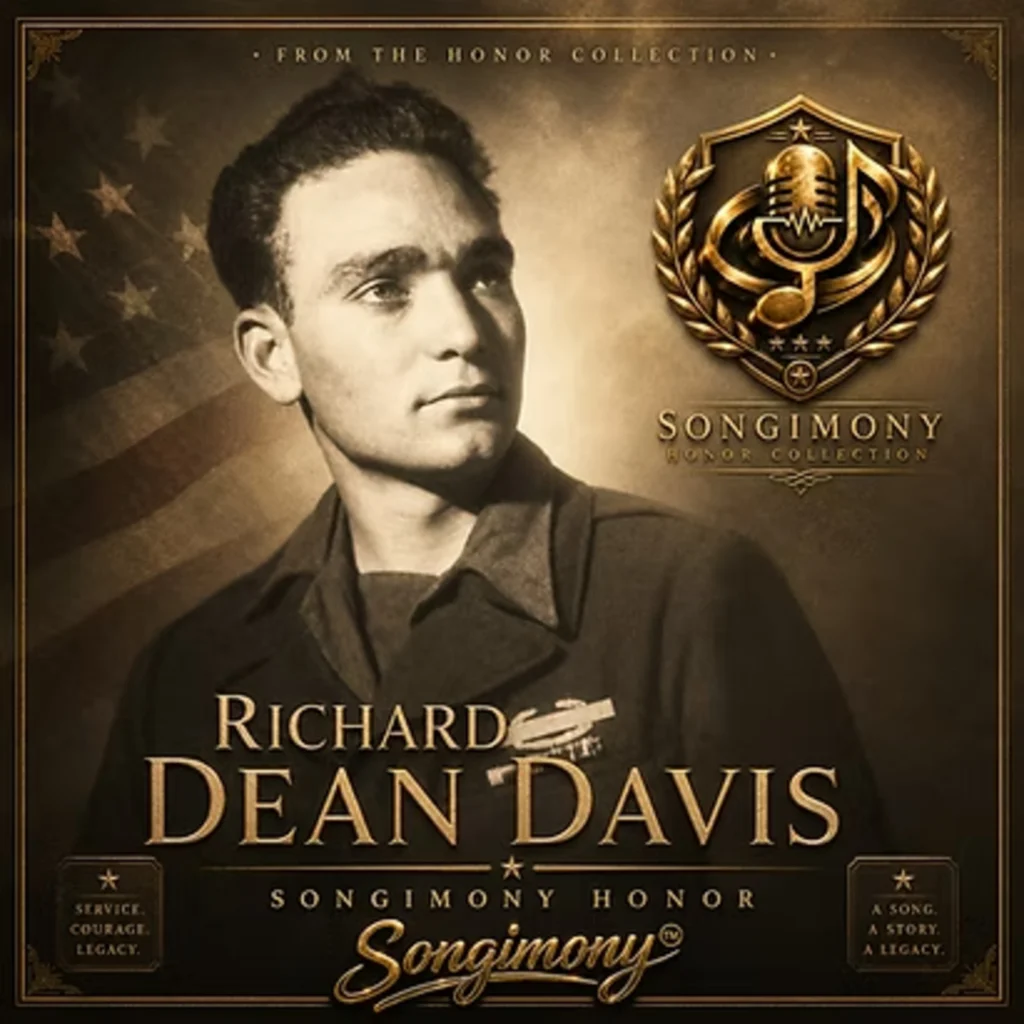
Dean Davis, Man of Faith
Some lives leave behind a stack of documents. Others leave behind a story.
“Dean Davis, Man of Faith” began with the discovery of both.
This Songimony was created to honor Richard Dean “Dean” Davis, a San Bernardino native and World War II veteran whose life emerged through a remarkable collection of surviving records: his Army separation document, contemporary newspaper accounts describing his wartime experiences, a personal letter written to his parents immediately following one of those experiences, and the discovery that Dean himself was a songwriter.
The research shaped not only what the song says, but how it sounds.
The Research Behind the Song
The starting point was Dean’s military record.
His Army separation document establishes the essential framework of his service: his enlistment, his assignment as a radio operator with the 56th Armored Infantry Battalion, his service in the European Theater, and his participation in the campaigns of Normandy, Northern France, the Ardennes, Rhineland, and Central Europe. It also records the Combat Infantryman Badge and his other wartime decorations.
But the document is administrative by nature. It tells us where Dean served without revealing the experience of being there.
That human dimension emerged through two contemporary newspaper accounts.
One describes Dean and two fellow Americans moving beyond their own lines near Celles, Belgium, after civilians reported that German soldiers were prepared to surrender. What they encountered was dramatically larger than expected, ultimately resulting in approximately 160 German prisoners being brought back to American lines, followed by the discovery of two more German soldiers nearby.
Another account identifies Dean among a small group of Americans who confronted a German tank column near the French-Belgian border and held the force for approximately fifteen minutes while American tanks moved into position.
Those accounts provided historical context, but one document gave the project its emotional center.
A Young Soldier’s Own Words
The day after the tank-column action, Dean wrote to his parents.
His letter was striking because he did not frame what happened primarily in terms of bravery or military achievement. Instead, he wrote about gratitude and his belief in divine protection.
He acknowledged that someone else might call what happened luck. Dean saw it differently, writing that “the hand of God was with me.”
That statement became the defining idea behind the Songimony.
The song therefore isn’t constructed as a conventional war tribute. It is a portrait of a young man trying to understand an extraordinary experience through his faith.
The title came naturally from that discovery:
Dean Davis, Man of Faith.
Why This Musical Style?
The musical direction became especially significant when the research revealed another part of Dean’s life: he was a songwriter himself.
Dean wrote many songs and gravitated toward the country storytelling tradition associated with Johnny Cash.
That discovery changed the creative approach.
Rather than placing Dean’s story into a modern cinematic or orchestral military sound, the Songimony was shaped around the musical language he would have recognized: country storytelling, acoustic textures, straightforward melodic movement, and an unadorned emotional delivery.
The Johnny Cash influence is not intended to imitate Cash or reproduce a particular recording. It is a connection to a musical tradition Dean himself loved—a tradition built around ordinary people, hard roads, faith, work, family, and stories that carry their weight without requiring elaborate production.
That makes the musical choice personal.
The song isn’t simply using country music because it fits the era.
It uses that language because it connects the finished Songimony to Dean’s own creative life.
Why the Song Exists
The purpose of this Songimony is not to turn Dean into a larger-than-life figure.
The surviving record does not require that.
Instead, the song seeks to preserve the connection between the different pieces of his life.
There was the young man from San Bernardino.
There was the soldier who crossed an ocean and served in the European Theater.
There was the radio operator who found himself in dangerous situations far beyond anything his hometown life could have prepared him for.
There was the believer who attributed his survival to God’s hand.
And there was the songwriter who expressed himself through the country music tradition he loved.
The song brings those identities into one place.
From History to Memory
The lyrics deliberately move between geography and identity: San Bernardino and Europe, youth and war, battlefield danger and personal faith.
The military campaigns are presented not as a history lesson, but as markers of the enormous distance Dean traveled from the life he knew.
The Belgian episode and the confrontation with the German tank column provide glimpses of the danger without turning the song into a battle chronicle.
And the reference to his letter home is intentionally simple.
“The hand of God was with me.”
Those words do not need embellishment.
They are Dean’s.
The final spoken passage returns to the documentary record, almost like closing the folder on a life that has just been opened for us: his name, his service, the campaigns, and the simple description that ultimately became the title of the song.
A son. A soldier. A man of faith.
The Songimony
Every Songimony has a reason for existing.
For Dean Davis, it is the intersection of history, faith, music, and memory.
The research gave us the facts.
The newspapers gave us the wartime moments.
His letter gave us his perspective.
His songwriting gave us the musical doorway.
And the Songimony brings those elements together in a form that can be heard rather than simply read.
Dean spent part of his life writing songs.
Decades later, a song has been written to remember him.
That is the circle at the heart of Dean Davis, Man of Faith.
Not a monument.
Not a military report set to music.
A story, carried forward in the musical language of a man who believed that, in the middle of one of the darkest conflicts in history, the hand of God was with him.