
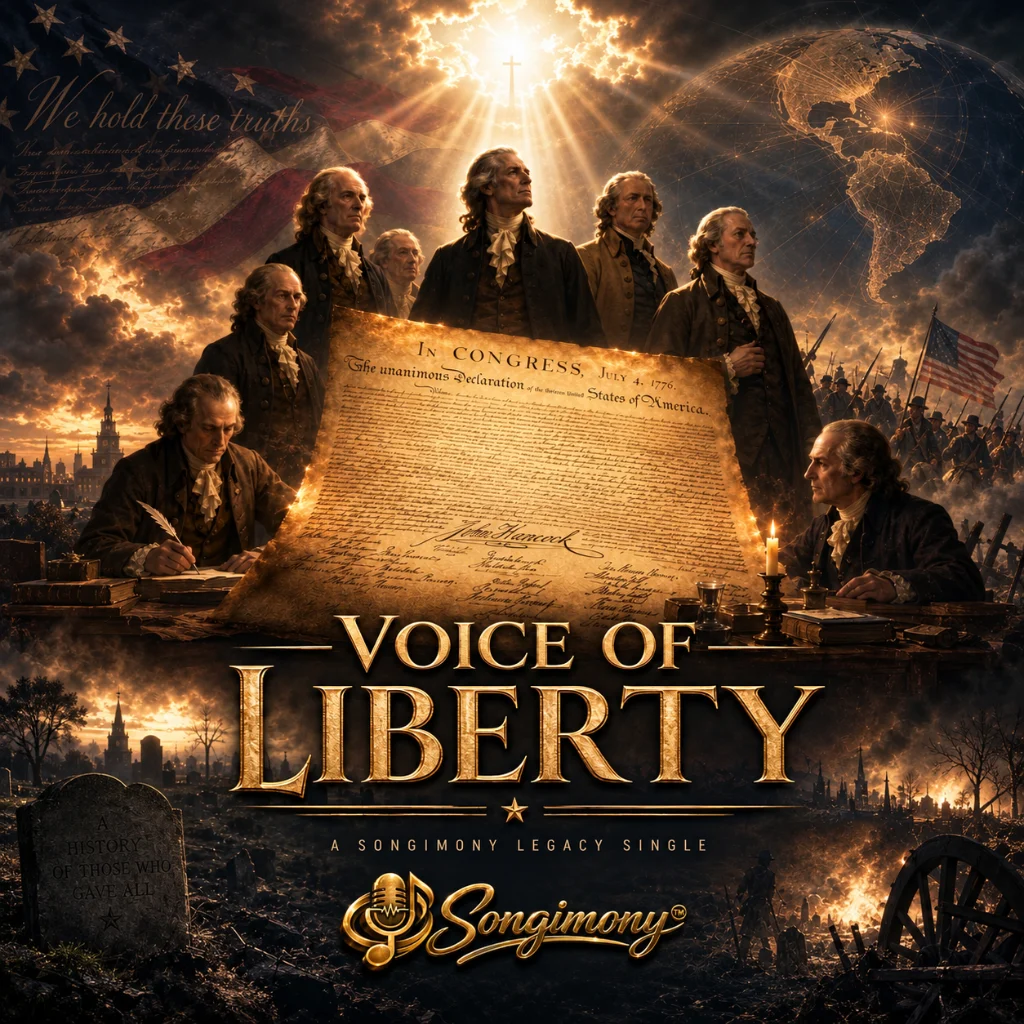
A Declaration Finds Its Voice
Voice of Liberty began with an unusual question:
What if the Declaration of Independence could tell its own story?
Rather than writing a song about the Declaration from the perspective of a modern observer, this Songimony™ gives the document a voice. The Declaration becomes the narrator—a witness that remembers the suffering, oppression, fear, sacrifice, and conviction that preceded its birth in 1776, and then watches its words travel through the centuries.
That creative decision became the foundation for everything that followed.
The song opens not on July 4, 1776, but much earlier:
“From candle smoke and restless prayers From winter winds and burdened air I rose beside the breaking dawn Before the old world knew I’d come”
The voice is almost prophetic. The Declaration is not yet a document. It is an idea forming in the darkness.
It has heard the chains.
It has witnessed suffering.
It has watched power concentrated in the hands of kings.
And then, eventually, it is given words.
Born From a Moment of History
The historical Declaration was adopted by the Continental Congress on July 4, 1776. Its opening establishes a philosophical foundation for independence, declaring that people possess rights endowed by their Creator and that legitimate government exists to secure those rights.
The song takes those ideas and turns them into a first-person narrative.
“And in the dark, a whisper stirred A trembling truth demanding words Not born from crowns or tyrants’ hands But written by the son of man”
Historically, the Declaration emerged from an intensely political process. Richard Henry Lee introduced the independence resolution in June 1776, and a committee of five was appointed to prepare the declaration explaining the decision. Thomas Jefferson produced the principal draft.
Artistically, however, the Songimony asks the listener to imagine the document itself waiting to be born.
The result is not a literal historical reenactment.
It is historical storytelling through personification.
Ink, Blood, and Sacrifice
One of the recurring ideas in the song is that liberty was not obtained merely by writing beautiful words.
It cost something.
“So they dipped their quills in defiant flame And signed their lives beneath my name”
And later:
“I was written in ink Born in blood by the will of God Carried through the smoke of war To place a torch in human hearts”
The Declaration itself does not claim that the signers literally knew they were signing a death warrant, although the popular phrase “our Lives, our Fortunes and our sacred Honor” captures the extraordinary commitment expressed in its conclusion. The actual document declares independence while appealing to the “Supreme Judge of the world” and asserting the colonies’ right to become free and independent states.
The Songimony compresses that historical reality into a poetic image:
ink represents the declaration;blood represents the sacrifice;fire represents the conviction;the torch represents the inheritance.
That imagery becomes increasingly important as the song progresses.
From America to the World
The Declaration speaks specifically from the American Revolution, but its language was deliberately expressed in universal terms.
The National Archives notes that the Declaration’s grievances were framed for an international audience and that its principles have continued to inspire people around the world.
That becomes the second act of Voice of Liberty.
The narrator leaves the thirteen colonies.
“I crossed the seas in tattered coats Inside the hearts of exiled souls I walked through prisons, fields, and scars Beneath revolts and fallen stars”
The Declaration becomes symbolic rather than geographically confined.
It travels through generations.
It enters revolutions.
It appears in the aspirations of people living under governments that deny liberty.
It becomes a torch passed from one generation to another:
“I am the flame Passed from fathers to their children A vow no darkness overcomes A dawn the world keeps living”
This is where the song expands beyond American patriotism into a meditation on the historical aspiration for human liberty.
Liberty Is Not a Crown
The most important turn in the song comes in its bridge.
After celebrating liberty, the narrator stops and warns that liberty itself can be misunderstood.
“But liberty is not a crown It cannot live where truth bows down It asks for courage, asks for grace For faithful hearts to embrace”
This is intentional.
The song does not define freedom as simply getting to do whatever one wants.
That distinction is fundamental to the Songimony’s religious foundation.
In Latter-day Saint teaching, agency is the ability and privilege God gives people to choose and act for themselves. The Church’s Gospel Topics material describes agency as essential to God’s plan and connects it directly with choosing liberty and eternal life.
The Book of Mormon puts the principle even more directly:
“Men are free … to choose liberty and eternal life, through the great Mediator of all men.”
—2 Nephi 2:27
That verse is one of the theological foundations underneath Voice of Liberty.
The song’s liberty is therefore not merely political.
It is moral.
It is spiritual.
It is ultimately about agency.
The Declaration and the Gospel
This is where the Songimony becomes distinctly Christian.
The Declaration speaks of rights endowed by the Creator.
The restored gospel teaches about agency given by God.
The Declaration speaks about freedom from political tyranny.
The gospel speaks about freedom from spiritual captivity.
The Declaration asks what legitimate government should protect.
The gospel asks what a human being should do with the freedom God has given.
The song brings those ideas together without suggesting that the Declaration is scripture.
Instead, it explores a powerful historical and theological parallel:
Political liberty protects the space in which human agency can be exercised.
And agency ultimately has an eternal purpose.
The Church teaches that agency allows people to act for themselves rather than merely be acted upon, and identifies choosing Jesus Christ and eternal life as the ultimate use of that agency.
That is why the song eventually reaches its most important statement:
“And the Son of God makes freedom ring”
The line changes the meaning of everything that came before it.
The Declaration can proclaim liberty.
A nation can protect liberty.
Generations can defend liberty.
But Christ is the source of the deeper freedom the Songimony ultimately celebrates.
“I Am No Perfect Nation’s Boast”
Perhaps the most important line for understanding the song is this:
“I am no perfect nation’s boast I am the debt the brave still owe”
That line deliberately prevents Voice of Liberty from becoming a simplistic celebration of national perfection.
The narrator is the Declaration—not America itself.
It does not claim that every promise has always been perfectly fulfilled.
Instead, it represents an ideal that continually challenges the people who inherit it.
The Declaration’s words have always existed alongside the complicated and unfinished history of the nation that produced them.
That tension is part of the song.
The torch is beautiful precisely because it is fragile.
“A fragile light through human hands A promise offered to every land”
Liberty is portrayed as an inheritance that can be neglected, distorted, or lost.
It therefore requires stewardship.
250 Years
The release of Voice of Liberty is especially meaningful in 2026, the 250th anniversary of the Declaration of Independence.
The National Archives is formally commemorating the anniversary through its Freedom 250 initiative. Its 2026 exhibition, Free and Independent: A Celebration of the Declaration, explores the document’s creation, preservation, and continuing significance 250 years after its adoption.
That anniversary provided the historical moment for this Songimony.
But the purpose is not simply to look backward.
The final section of the song turns directly toward the future:
“So lift the fire Guard the flame Let independence know your name”
The Declaration is no longer doing the work.
We are.
The narrator has carried the listener from the past into the present and then hands the torch away.
That is the central creative device of the entire song.
From Ink to Blood, From Dust to Dawn
The closing image completes the journey:
“From ink to blood From dust to dawn The flame goes on The flame goes”
The parchment began as ink.
The Revolution made its words costly.
History carried them forward.
Generations inherited them.
And now the listener receives them.
The final repetition of “The flame goes” is intentionally unresolved.
It doesn’t say where the flame goes.
It doesn’t say who carries it.
That is the point.
The next person carrying it is the listener.
The Musical Architecture
The music was designed to follow the same emotional journey as the lyric.
Americana Folk Rock — 78 BPM — D minor / F major
The production combines:
- Acoustic guitar arpeggios
- Piano ostinato
- Legato cello lines
- Distant bell tolls
- Soft string swells
- Marching snare rolls
- Brass accents
- Timpani
- Cinematic percussion
- Massive choir harmonies
- Deep male baritone lead
- Prophetic vocal delivery
- Warm analog-room ambience
- A dramatic key lift
- A progression from solemn to triumphant
The acoustic guitar and piano establish the human, historical character of the opening. The cello adds weight beneath the narrator, while distant bells suggest memory and the passing of generations.
As the story expands, percussion and orchestration gradually become more pronounced.
The marching snare does not turn the song into a military march. Instead, it represents movement—people moving through history, generations moving forward, and the relentless march of an idea.
The brass and timpani introduce scale.
The choir introduces something larger than an individual voice.
And by the orchestral climax, the solitary voice of the Declaration has become a collective human cry.
Why a Deep Male Baritone?
The vocal choice was central to the concept.
The narrator needed to sound neither like a contemporary pop singer nor like a traditional patriotic vocalist.
The deep male baritone gives the Declaration an ancient, weathered, prophetic quality.
It sounds like a voice that has been carrying a message for centuries.
The performance begins restrained and observational.
As the story develops, it becomes increasingly declarative.
By the final section, the narrator is no longer simply remembering history.
He is calling the present generation to responsibility.
The Songimony’s Story Arc
The complete song follows a deliberate narrative progression:
Witness The narrator sees suffering and oppression.
Awakening A truth begins demanding words.
Birth The Declaration is written and signed.
Sacrifice The Revolution turns words into blood and commitment.
Journey The ideals travel beyond America’s shores.
Inheritance The flame passes from generation to generation.
Warning Liberty cannot survive without truth, courage, grace, and responsibility.
Agency Freedom becomes connected to God’s gift of moral choice.
Christ The story ultimately points toward the freedom found through the Son of God.
Commission The listener is handed the flame.
That final movement is what transforms the song from a historical anthem into a Songimony™.
The Sources Behind the Song
The historical foundation begins with the Declaration of Independence itself. The National Archives’ authoritative transcription preserves the original spelling and punctuation of the parchment document, including its language concerning the Creator, unalienable rights, liberty, government, and the people’s right to alter destructive government.
Read the Declaration of Independence — National Archives
The National Archives also provides historical context for how the Declaration came into being and the political process leading to independence.
How the Declaration of Independence Came to Be — National Archives
For the 250th anniversary itself:
Freedom 250 — National Archives
Free and Independent: A Celebration of the Declaration
The religious foundation comes primarily from the restored gospel’s teachings concerning agency, liberty, and Jesus Christ.
2 Nephi 2:26–27 is particularly important because it explicitly connects freedom, agency, liberty, eternal life, and the “great Mediator” of mankind.
2 Nephi 2 — Church of Jesus Christ of Latter-day Saints
The Church’s explanation of agency further establishes the theological distinction between freedom of choice and simply doing whatever one desires.
And the foundational Christian declaration beneath the song’s final movement is the Savior’s teaching in John 8:36:
“If the Son therefore shall make you free, ye shall be free indeed.”
That is ultimately where Voice of Liberty arrives.
The Meaning of the Flame
The flame in this Songimony has several meanings simultaneously.
It is the fire of resistance.
It is the torch of liberty.
It is the light of truth.
It is the inheritance of one generation to another.
And ultimately, it represents the light that points toward Christ.
That is why the final image is not a flag, a battlefield, a king, a politician, or even a document.
It is a flame.
Because documents can age.
Nations can change.
Empires can fall.
Generations pass away.
But an idea can continue.
And a testimony can continue.
From ink to blood.From dust to dawn.The flame goes on.
Voice of Liberty is Songimony™’s musical remembrance of 250 years of the Declaration of Independence—and a reminder that the freedom inherited from history carries with it a responsibility for the future.
The Declaration spoke in 1776.
In 2026, the question is no longer simply what did it say?
The question is:
What will we do with what it said?